
Reviewed · COMMUNISM TOURS
WWII and Communism History in Prague’s Old Town Private Tour
Prague’s prettiest streets carry some of its darkest stories. This private walk connects the Jewish quarter, the 1945 Prague Uprising, the former Gestapo headquarters, and the 1989 Velvet Revolution in one clear route through the Old Town.
I like the private format, which gives you room to ask questions, and the way the tour links Nazi occupation to Communist rule instead of treating them as separate chapters. I also like the optional Museum of Communism, though the two-hour version can feel brisk if you want a full discussion at every stop.
The two-hour walk covers Josefov, Old Town Square, Petschek Palace, and Wenceslas Square. The four-hour choice adds the museum, and at $104 per person, the price makes the most sense for people who value a personal guide and serious historical context.
Key points to know before you book
- Josefov begins the story: See the Maisel and Spanish Synagogues while learning about deportations to Theresienstadt and the Nazi plan for a museum devoted to an extinct people.
- Old Town Square reveals the 1945 battle: The Astronomical Clock and Old Town Hall suffered heavy damage during the Prague Uprising from May 5 to 9.
- Petschek Palace carries a grim memory: The former Gestapo headquarters helps explain the work, suffering, and courage of the Czech resistance.
- Wenceslas Square links two dictatorships: The square hosted Nazi demonstrations and later became a center of the 1989 Velvet Revolution.
- The four-hour option adds the Communist Museum: Its exhibits cover the Cold War, Prague Spring, the Soviet invasion, Jan Palach, censorship, political trials, and the end of Communist rule.
- Strong guide reports: Sofija is praised for her broad knowledge and lively anecdotes, while Markéta is singled out for an entertaining and well-informed approach.
A serious history walk through Prague’s Old Town
This is not a tour built around grand interiors or postcard views. It is a story of occupation, resistance, state violence, political control, and the long push toward democracy.
You meet your private guide in front of the World of Franz Kafka at Náměstí Franze Kafky 16/1. From there, the route moves through central Prague on foot. The exact number of stops depends on your choice, but the main two-hour walk follows a logical line from Josefov to Old Town Square, then to Petschek Palace and Wenceslas Square.
That route works well because each place adds another layer. You begin with the fate of Prague’s Jewish population, move to the final battles of the war, then examine Nazi repression before ending with Communist rule and the Velvet Revolution.
A private guide also changes the pace. You can stop for a question, ask for a clearer explanation of a political term, or spend more time on the subject that matters most to you. The available languages are English, French, German, Italian, Polish, Russian, Spanish, and Czech.
More Private Tours in Prague
- Prague Old Town: Private Tour
★ 5.0 · 1,223 reviews - Prague Airport Private Arrival Transfer
★ 4.5 · 991 reviews - Prague Airport Private Departure Transfer
★ 4.5 · 780 reviews
Josefov and the planned museum of a destroyed people
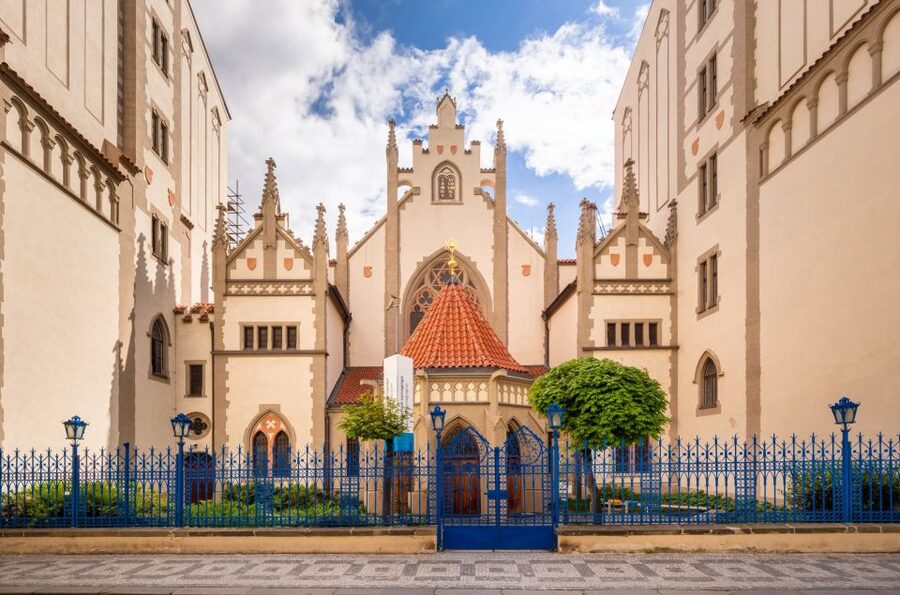
Josefov is one of the best preserved Jewish quarters in Europe, and it gives the tour a powerful opening. You see the Maisel Synagogue and the Spanish Synagogue while learning what happened to Czech Jews during the Nazi occupation.
The guide explains the transports to Theresienstadt, the concentration camp and ghetto north of Prague. You also hear about Hitler’s plan to create a museum of the extinct race, a chilling project that treated Jewish lives, religious objects, and culture as material for an exhibition after their destruction.
That context matters because Josefov can otherwise feel like a collection of beautiful historic buildings. The synagogues are visually impressive, but this tour asks you to look beyond architecture. You learn how the Nazi regime tried to erase a living community while preserving selected objects as evidence of a people it intended to destroy.
You should expect this part to be emotionally heavy. The subject is not handled as a quick list of dates, and families with younger children may want to consider how comfortable they are with discussions of deportation, persecution, and mass murder.
The walking route does not list entry into the synagogues as part of the two-hour option. Your main experience here is the guide’s explanation from the streets and public areas, with the buildings providing the setting.
Old Town Square and the Prague Uprising

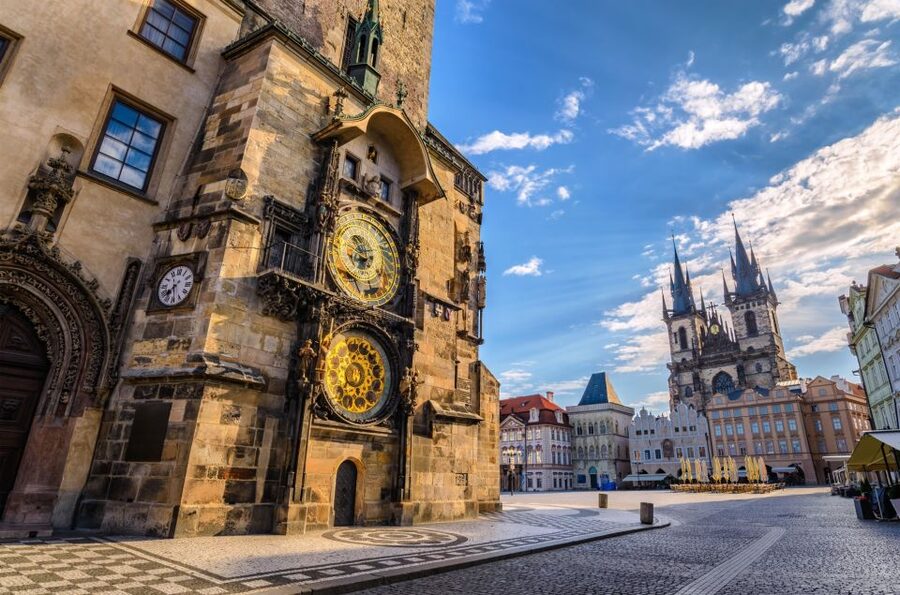
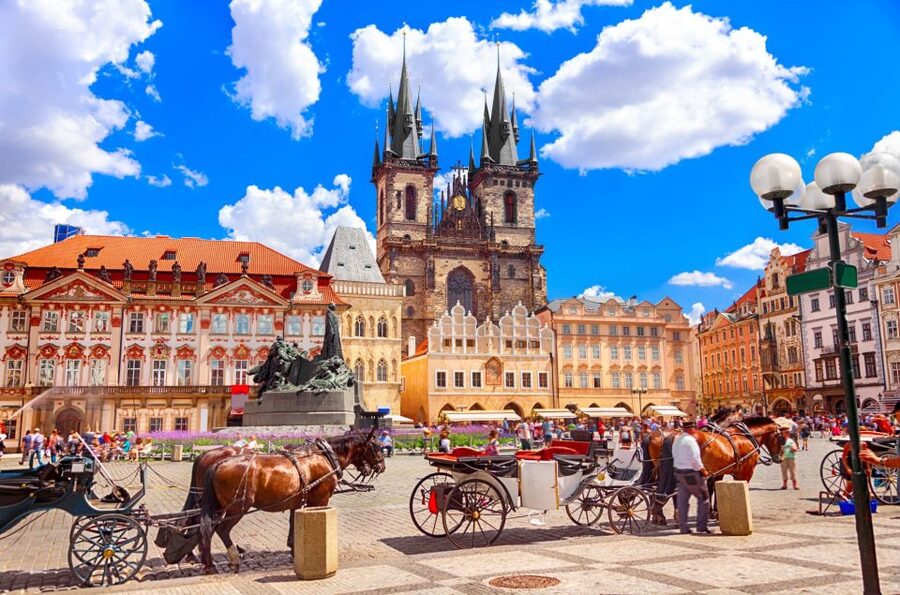
The tour then reaches Old Town Square, where Prague’s Astronomical Clock and Old Town Hall provide a striking backdrop to the final days of the Second World War.
From May 5 to 9, 1945, Prague rose against German occupation. The fighting damaged the Old Town Hall, including the area around the famous clock. It is easy to miss those marks when you are watching the clock’s moving figures or looking across the square at its busy facades.
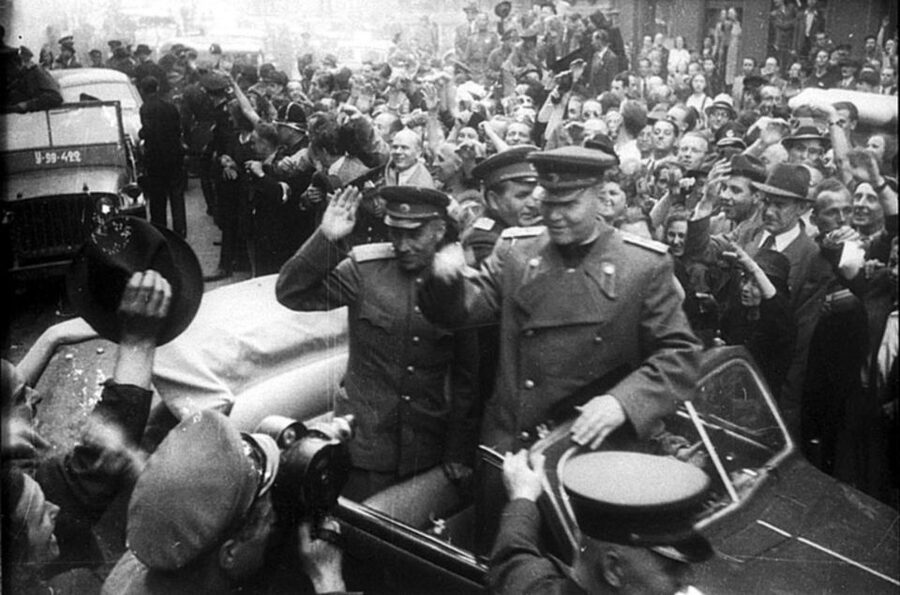
Your guide explains the Prague Uprising and the city’s liberation, including the role of the Red Army. The political afterlife of that liberation is just as important as the military events. The Communist Party later used the Red Army’s involvement to build support for Communist rule in Czechoslovakia.
I appreciate that the tour does not present liberation as a simple final chapter. The end of Nazi occupation brought freedom from one dictatorship, but it also helped create conditions that the Communist Party used to gain influence. That link gives the walk a clear thread instead of a series of disconnected tragedies.
The square can be crowded, especially at popular times, so you will need to stay close to your guide. A private group helps here. You are less likely to lose the thread of the story than you would be in a large group gathered around a single guide.
Petschek Palace and the machinery of Nazi repression

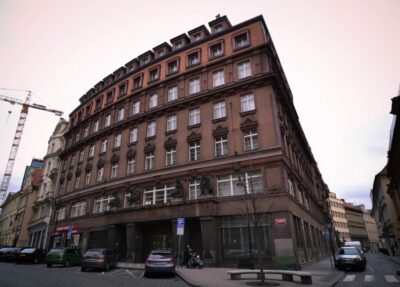
The next major stop is Petschek Palace, once the headquarters of the Gestapo in Prague. The building is an important contrast to the open public space of Old Town Square.
At the corner, a memorial plaque honors the Czech resistance. Here the guide discusses resistance work, interrogations, and torture. You gain a better sense of what resistance meant in practice: secrecy, risk, fear, and the possibility of brutal punishment if the Gestapo uncovered your efforts.
This stop is valuable because it puts faces and choices behind the larger word resistance. You are not simply hearing that people opposed the occupation. You are hearing about the pressure placed on those who worked against it and the cost paid by people who were caught.
Petschek Palace is mainly an exterior stop on this walk. Do not book the tour expecting a museum visit inside the former Gestapo headquarters. Its value comes from the guide’s account and the memorial marker, placed on a building that once served the occupying regime.
More Old Town walks in Prague:
- Prague: Old Town Hall Tower Entry Ticket
★ 4.5 · 6,749 reviews - Prague: 3-Hour Walking Tour of Old Town & Prague Castle
★ 4.7 · 5,696 reviews - Prague: 3-Hour Old Town and Prague Castle Tour in German
★ 4.8 · 5,671 reviews - Prague Old Town, Medieval Underground and Dungeon Historical Tour
★ 4.5 · 3,227 reviews
Wenceslas Square, from Nazi rallies to the Velvet Revolution
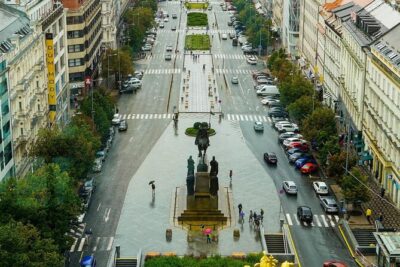
The walk ends at Wenceslas Square, one of the most useful places in Prague for understanding the country’s modern political story.
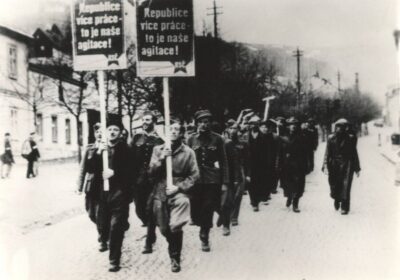
The Nazis used the square for mass demonstrations during the occupation. Decades later, the same broad public space filled with people during the 1989 Velvet Revolution. Those demonstrations helped end Communist rule in Czechoslovakia and opened the way toward independence and democracy.
Your guide connects the square to the people and events of the Velvet Revolution. The location makes the lesson especially clear: public space can be used to display state power, but it can also become a place where ordinary people gather to challenge that power.
This final stop gives the two-hour version a strong ending. You have moved from the destruction of Jewish life, through wartime resistance and liberation, to a later struggle against censorship and totalitarian government.
The route also leaves you in a useful part of central Prague. If you have more time, you can continue exploring from Wenceslas Square, though no additional sightseeing is included in the tour itself.
What the four-hour Museum of Communism adds
If you want more than a brisk overview, choose the four-hour option. It includes regular admission to the Museum of Communism, while the basic two-hour option does not include a museum ticket.
The museum covers four decades of Communist rule in Czechoslovakia. The subjects include:
- The Cold War
- The Prague Spring
- The Soviet invasion of 1968
- Student Jan Palach
- Propaganda and censorship
- Political trials and executions
- The Velvet Revolution
The museum adds needed detail to the walking route. On the street, you learn where major events happened and how public spaces were used. Inside the museum, you gain more help with the machinery of the regime and daily life under Communist rule.
The Prague Spring and the Soviet invasion of 1968 are especially important for understanding modern Czech identity. The Prague Spring was an attempt to reform Communism, but Soviet-led forces invaded to stop the changes. The tour also covers Jan Palach, the student whose suicide became a powerful protest against the invasion and the loss of reform.
The museum is the better choice if you want to understand how a totalitarian state operates beyond its famous dates. Propaganda, censorship, political trials, and executions show how control worked through information, fear, and punishment.
Allow four hours for a more measured experience. The two-hour walk is better for a first orientation or a tight schedule. The longer option gives the subject room to breathe, though it also asks you to spend much of your day with difficult material.
The private guide makes the difference
This tour depends heavily on the guide. The route itself is easy to follow, but the meaning of Josefov, Petschek Palace, and Wenceslas Square comes from the explanation.
Sofija has been praised for answering questions with ease, adding small anecdotes, and presenting political events in a clear and engaging way. Her age is not treated as a limitation. The useful point for you is that she can connect broad Czech history with personal details instead of simply reciting dates.
Markéta is also praised for an entertaining style and strong command of the subject. That matters on a serious tour. The material includes deportation, torture, executions, invasion, and suicide, so a guide who can speak clearly and hold your attention is a real benefit.
One French-speaking participant described the guide’s personal stories as a way to make the country’s past feel more immediate. That suggests a strength of the private setup: the conversation can move beyond a prepared speech when your questions lead somewhere unexpected.
Of course, guide quality can vary by assignment and language. The experience is not an audio guide with a fixed script, and your guide’s approach will shape the balance between dates, anecdotes, and discussion.
Is $104 per person good value?
At $104 per person, this is not the cheapest way to walk around Prague. You are paying for a private group, a live guide in your chosen language, and a focused route built around the city’s twentieth-century political history.
The value improves if you are traveling with several people, since a private tour lets your group share the guide rather than booking separate places on a large group walk. It also makes more sense if you have limited time and want one organized route through several important locations.
The four-hour option includes regular Museum of Communism tickets, which adds practical value. If you plan to visit the museum anyway, the longer tour combines admission with interpretation and a walking route that explains its subjects in place.
The price is harder to justify if you want only a general introduction to Prague or prefer to explore independently. You can see the exterior locations without a guide, but you will miss the connections between the Nazi occupation, the 1945 uprising, Communist consolidation, and the Velvet Revolution.
Who should book this tour?
I would recommend this tour to you if you enjoy political history, memorial sites, and city walks that focus on events rather than shopping and architecture. It suits first-time visitors who want a clear introduction to Prague’s twentieth century, as well as returning visitors who want to look past the usual castle and bridge circuit.
The tour is also a good match for families with older teenagers, university groups, and private parties with different levels of background knowledge. You can ask the guide to explain terms and events at the right level instead of relying on a one-size-fits-all script.
You should think twice if you want a light sightseeing walk. The subjects are serious from the opening stop, and the Communist Museum makes the experience more demanding. People with mobility concerns should know that this is a walking tour, although the activity is listed as wheelchair accessible.
The available languages make it useful for international groups. Check your email the day before for important information, and confirm the starting time when you book, since times depend on availability.
Should you book it?
Book it if you want Prague’s landmarks to make political sense. The route links Josefov, the Prague Uprising, Gestapo repression, Communist rule, and the Velvet Revolution with a clear historical line.
Choose two hours for a focused walk and four hours if you want the Museum of Communism and a fuller account of life under the regime. I would choose the longer option for anyone genuinely interested in modern Czech history, and the shorter one for visitors who want a strong introduction before moving on to other parts of Prague.
The main drawback is not poor organization or a weak route. It is the subject itself. This is a serious tour, but it gives you a more honest understanding of Prague than a walk limited to pretty squares and famous clocks.
FAQ
Where does the tour meet?
Meet your guide in front of the World of Franz Kafka at Nám. Franze Kafky 16/1, 110 00 Staré Město, Czechia.
How long does the tour last?
You can choose a two-hour walking tour or a four-hour option that includes the Museum of Communism.
What places are included in the two-hour tour?
The two-hour route includes Josefov, the Maisel Synagogue, the Spanish Synagogue, Old Town Square, Petschek Palace, and Wenceslas Square. The exact number of attractions depends on the selected option.
Is the Museum of Communism included?
Regular admission to the Museum of Communism is included only with the four-hour option. The ticket is not included in the basic two-hour tour.
What does the Museum of Communism cover?
The museum covers four decades of Communist rule, including the Cold War, Prague Spring, the Soviet invasion of 1968, Jan Palach, the Velvet Revolution, propaganda, censorship, political trials, and executions.
Which languages are available?
The live guide is available in English, French, German, Italian, Polish, Russian, Spanish, and Czech.
Is this a private tour?
Yes. The activity is organized for a private group.
Is the tour wheelchair accessible?
The activity is listed as wheelchair accessible.
What is the price?
The listed price is $104 per person.
Can I cancel the booking?
You can cancel up to 24 hours in advance for a full refund. You can also reserve now and pay later.
More Communist Era Tours in Prague
- Prague: Communism History and Nuclear Bunker Guided Tour
★ 4.7 · 2,417 reviews - Prague Communism History and Nuclear Bunker Tour
★ 5.0 · 1,742 reviews - Communism & Nuclear Bunker Tour + 70s Canteen Lunch (own expense)
★ 5.0 · 1,036 reviews - Prague: Communism and Bunker Tour with 70s Canteen Lunch
★ 4.8 · 250 reviews
More Wartime History Near Prague
- Prague: WWII Guided Tour & The Crypt of Operation Anthropoid
★ 4.7 · 1,030 reviews - WWII in Prague Tour & The Crypt of Operation Anthropoid
★ 5.0 · 817 reviews - Small-Group World War 2 & Operation Anthropoid Tour in Prague
★ 5.0 · 231 reviews - Prague: World War 2 and Operation Anthropoid Walking Tour
★ 4.8 · 193 reviews
Just added around Prague
- World War II 4WD Tour from Prague with Lunch★ 4.4 · 3 reviews
- Wroclaw to Prague: 2-in-1 (Private Transfer + Country Tour)★ 5.0 · 4 reviews
- Prague: Historical Walking Tour with Focus on World War 2★ 4.3 · 12 reviews
- Walking tour of Prague in french: Old Town & Charles Bridge★ 4.9 · 62 reviews
- Ultimate Unlimited Beer Pong with Czech Beer★ 4.6 · 5 reviews
- Walking tour of Prague in French : Nové Město★ 4.9 · 16 reviews
- Prague: Modern Private Spa with Jacuzzi and Sauna★ 4.8 · 62 reviews
- Unique salt cave in Prague★ 4.9 · 10 reviews
Communism Tours, compared.
Communism History and Nuclear Bunker Guided Tour
Read our review →
Communism & Nuclear Bunker Tour + 70s Canteen Lunch (own expense)
Read our review →
Second World War & Communism (Tip-based 3 hour tour)
Read our review →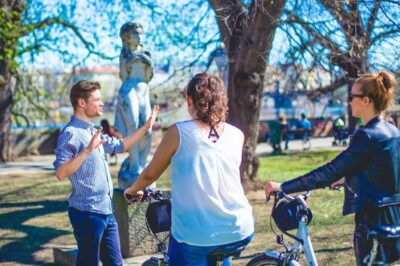
Browse the lists this tour appears in