
Reviewed · COMMUNISM TOURS
Prague Communism tour with visit of Communism museum
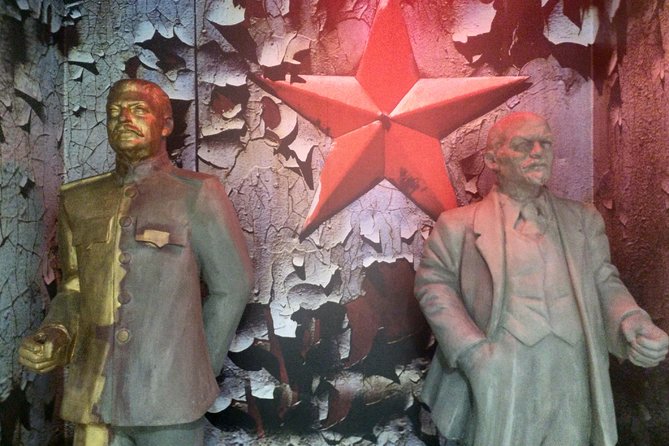
Prague’s communist past is easiest to understand when you connect the museum displays with the actual streets where people protested, suffered, and demanded change. This private tour does exactly that, pairing the Museum of Communism with Wenceslas Square, Národní třída, and the Jan Palach Memorial.
I like the personal scale, since your group gets the guide’s full attention. I also like the way guide Lenka has used family stories to explain daily life under the regime, not just dates and political names. The main drawback is cost: $114.39 per person is a serious outlay, and the museum ticket adds another €15.
Key points at a glance
- Private three-hour format: Only your group takes part, giving you room to ask questions and set the pace.
- Museum plus city streets: The indoor displays make more sense after you see the places tied to the 1948 takeover and the 1989 Velvet Revolution.
- Lenka’s personal connection: When Lenka leads, she adds family stories from life under communism to the wider political story.
- Four meaningful Prague stops: The route includes the Museum of Communism, Wenceslas Square, Národní třída, and the Jan Palach Memorial.
- Extra museum charge: The tour price does not include the €15 admission ticket.
- Useful in poor weather: The tour operates in all weather, with a substantial indoor museum visit built into the schedule.
Why this tour helps explain modern Prague
Prague’s old churches, grand squares, and elegant cafés can make the city’s recent past easy to overlook. Yet from 1948 to 1989, Czechoslovakia lived under communist rule, with political control reaching into work, education, travel, speech, and private life.
A standard city walk may point out a beautiful square and move on. This experience asks what happened there when the square became a stage for political pressure and public protest. That shift in focus is the tour’s real value.
You begin with the Museum of Communism, then walk through central Prague to places linked with the period’s major turning points. The format gives you both broad context and physical reference points. You do not just hear that the Velvet Revolution happened in Prague. You see where it began to gather force.
The private setup matters here. Communist-era history can lead to complicated questions, and you may want to pause over a detail that a large group would pass by. With only your party participating, the guide can spend more time on the subjects that matter most to you, from censorship and political control to family life and the experience of young people.
More communist era tours in Prague:
- Prague: Communism History and Nuclear Bunker Guided Tour
★ 4.7 · 2,417 reviews - Prague Communism History and Nuclear Bunker Tour
★ 5.0 · 1,742 reviews - Communism & Nuclear Bunker Tour + 70s Canteen Lunch (own expense)
★ 5.0 · 1,036 reviews
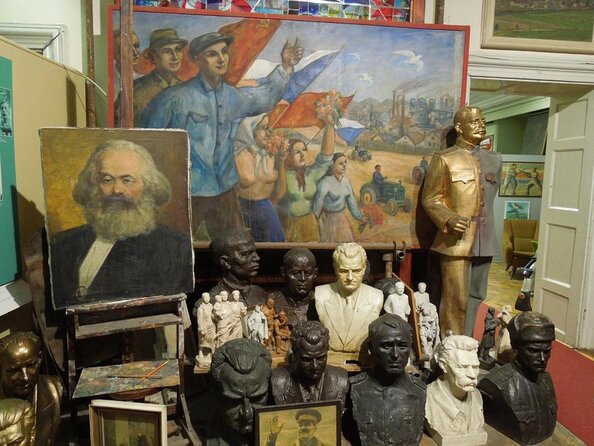
Starting at the Museum of Communism
The tour includes about 90 minutes at the Museum of Communism, with admission purchased separately. At €15 per person, the extra ticket is worth factoring into your total before booking.
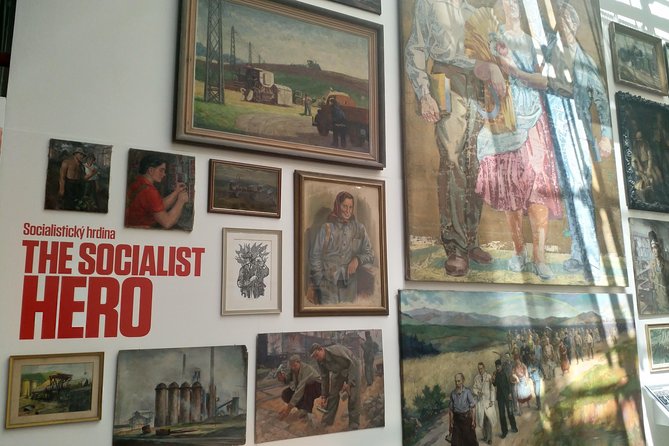
The museum provides the backbone for the experience. It gives you a structured account of communist Czechoslovakia, which is useful before or after seeing the related sites outdoors. Displays can help place the later street stops in a wider sequence, from the postwar political shift to the events that led to the end of one-party rule.
I especially like the museum’s role as a shared reference point between you and the guide. Instead of treating the exhibits as a quick self-guided visit, the tour lets you connect what you see indoors with what you later encounter in the city center.
The order of the experience gives the museum a strong opening role. You start with explanations and objects, then step outside to see where events unfolded. If your guide is Lenka, expect more than a textbook account. She has described growing up under communism and uses stories about relatives and friends to show how state policy affected ordinary households.
That personal angle can make an unfamiliar political system easier to grasp. A term such as repression can feel distant in a display case. A family story about restricted choices, pressure, or the limits of everyday life gives the idea a human scale.
Allow the full 90 minutes for the museum. Rushing through it would weaken the rest of the tour, since the street stops work best when you already understand the basic timeline. Remember that the ticket is not included, so you should be ready to pay the €15 admission fee separately.
Wenceslas Square and the public stage of Prague
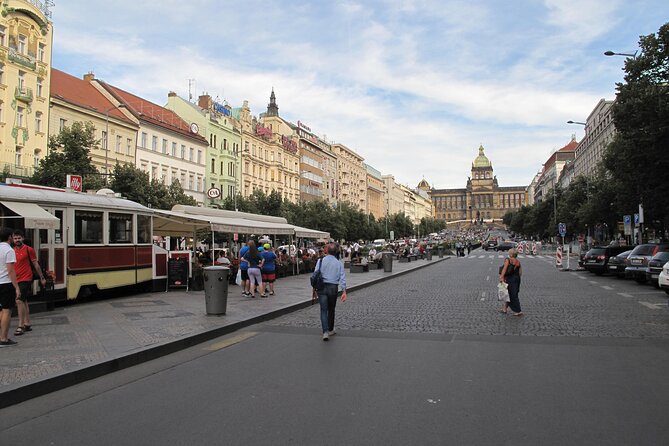
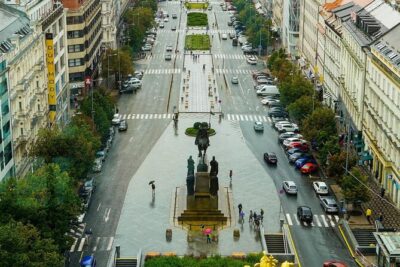
The next stop is Wenceslas Square, with about 20 minutes for the visit. This is not a long sightseeing pause. It is a focused history stop, and the guide’s job is to explain why this broad central space has mattered during major Czech events.
The square helps you picture how political life moved into public view. Large demonstrations and speeches need a setting where people can gather, and Wenceslas Square has served that role. Here, the guide can connect the physical space to the changing mood of Prague during the communist period and the movement toward freedom.
I value stops like this because they correct a common problem with museum-only visits. Indoor exhibits give you facts, but a public square shows the scale of civic action. You begin to understand why certain locations mattered when large numbers of people chose to appear together.
Twenty minutes is enough for an explanation, but not for a lengthy sightseeing break. You should expect a short talk and orientation rather than a long exploration of every building around the square. That is appropriate for this tour, which is focused on political history rather than general architecture.
The Jan Palach Memorial and the cost of protest
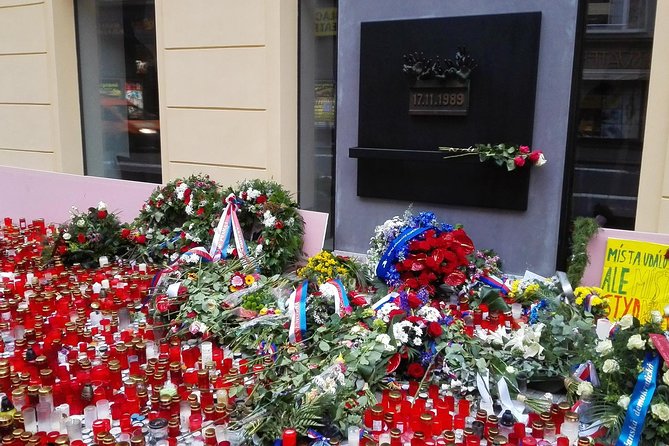
The route also includes the Jan Palach Memorial, again for about 20 minutes. The memorial concerns Jan Palach, a student who set himself on fire in protest. His action and its memory form one of the most painful parts of the story.
This stop gives the guide a chance to discuss protest at its most extreme. It also shows why the period cannot be reduced to a tidy march from oppression to freedom. People faced fear, pressure, and personal risk, and some chose dramatic acts to force public attention onto the country’s condition.
The memorial is in the center, making it easy to connect with the surrounding city rather than treating it as a distant monument. A guide can explain the significance of the site, then give you time to consider it. You should expect a serious stop, not a light sightseeing moment.
A useful detail from the walking portion is the mention of sculptures and commemorative markers tied to suffering under oppression. These can include memorial works that portray damage to the human spirit, along with brass plates set into pavements to remember people taken from their homes during the Nazi era. Those plates are not strictly a communist-era subject, but they show how Prague’s streets hold several layers of 20th-century trauma.
That wider context can be valuable, as long as you remember the tour’s main focus remains communism and the road to the Velvet Revolution. The memorial stops add emotional weight to the political timeline.
More museums in Prague:
- Prague: Museum of Fantastic Illusions Entry Ticket
★ 4.3 · 4,337 reviews - IAM Illusion Art Museum Entry Ticket
★ 4.2 · 1,664 reviews - Prague: Museum of Senses Admission Ticket
★ 4.0 · 1,445 reviews - IAM Illusion Art Museum Prague Fast Pass Ticket
★ 5.0 · 957 reviews
Národní třída and the Velvet Revolution
The tour ends at Národní třída, the location associated with the spark of the Velvet Revolution. The stop lasts about 20 minutes and places you at the heart of the events that helped bring communist rule to an end in Czechoslovakia.
This is one of the most useful parts of the walk because it links a national political change to a specific central Prague street. The phrase Velvet Revolution can sound almost gentle, but the transformation it describes came after decades of control and public frustration. A guide can explain how demonstrations, public solidarity, and pressure helped change the country.
Ending here gives the walk a clear direction. You begin with the system and its effects, visit places connected to protest and sacrifice, and finish where the movement toward political change gained force. The sequence creates a sense of cause and consequence without pretending that history is simple.
The end point is Národní třída in central Prague, close to public transportation. That makes the finish practical. You can continue sightseeing, find a café, or return to your hotel without making your way back to the starting point.
What Lenka’s personal stories add
Guide quality matters more on a history tour than on a simple orientation walk. If Lenka leads your tour, her personal connection is an important part of the experience. She grew up under communism and has used stories about her family and friends to explain how the period affected people close to her.
That perspective adds something a museum label cannot. You may learn how official control shaped personal choices, family expectations, and ordinary routines. The political facts remain important, but they become easier to remember when attached to real human consequences.
Lenka has also been praised for being friendly, professional, and able to explain the period clearly. The most useful quality here is not a stream of dates. It is the ability to answer questions and connect the displays to the streets outside.
You should still keep your expectations sensible. A three-hour tour cannot provide a full university course on Czechoslovak history. It can give you a strong framework, a few memorable human stories, and enough context to continue learning on your own.
Is $114.39 plus €15 a fair price?
At $114.39 per person, plus the €15 museum admission, this is not a budget walking tour. The cost makes more sense if you value a private guide and want focused discussion rather than a large group moving from one stop to the next.
The private format is the key value point. Only your group participates, so you can ask about subjects that interest you and spend less time on material you already understand. For families, couples, or small groups with a serious interest in 20th-century history, that control can justify the price.
The cost is harder to defend if you mainly want a quick introduction to Prague or prefer to explore museums at your own pace. You are paying for interpretation, personal attention, and the link between indoor displays and outdoor sites. If those elements matter to you, the tour offers more than a basic admission ticket and a self-guided walk.
The average booking lead time is about 54 days, so planning ahead is sensible if you have fixed dates. Group discounts are available, which may improve the per-person value for a larger party. The tour is offered in English.
Timing, weather, and practical details
The advertised duration is about three hours. The listed stops account for roughly two hours and 30 minutes, with the remaining time allowing for walking, meeting, and transitions. Treat the schedule as an approximate block rather than a minute-by-minute program.
The meeting point is 4, V Celnici 1031, in Prague 1. The tour finishes at Národní třída, also in the city center. Since the end point differs from the start, you finish in a useful area rather than returning across town.
The tour runs in all weather. Wear suitable clothing and comfortable shoes, since the experience combines an indoor museum visit with a central-city walk. Public transportation is nearby, and most people can take part. Service animals are allowed.
Free cancellation is available if you cancel at least 24 hours before the start time. Cancellations made less than 24 hours ahead are not refunded, and changes inside that period are not accepted. The cut-off follows local Prague time.
Who should book this Prague history tour?
I would recommend it most strongly if you already know you want to understand Prague beyond its medieval center. It suits anyone interested in communism, protest movements, the Cold War period, or the personal effects of political control.
It is also a good fit if you prefer asking questions instead of listening quietly in a large group. The private format works especially well for families and small groups with different levels of background knowledge.
The tour is less suitable if you want a general Prague highlights walk, a low-cost activity, or a long museum visit with no guide. The outdoor stops are short, and the subject can be solemn. You should book it for the history, not for casual sightseeing.
Should you book it?
Book this tour if you want Prague’s communist past explained through both personal stories and real locations. The Museum of Communism supplies the structure, while Wenceslas Square, the Jan Palach Memorial, and Národní třída show how that history played out in public.
The price is high once you add the €15 museum ticket, but the private attention and guide-led interpretation are the reason to choose it. If possible, request or confirm whether Lenka will lead your visit, since her experience of growing up under communism adds a particularly personal layer.
Skip it if you are watching every euro or already have a strong understanding of the period. For most visitors who want a serious, focused look at modern Czech history, this is three hours well spent.
FAQ
How long does the Prague Communism tour last?
The tour lasts approximately three hours.
What places are visited?
The tour visits the Museum of Communism, Wenceslas Square, the Jan Palach Memorial, and Národní třída.
Is the Museum of Communism admission included?
No. The museum ticket costs €15 per person and is not included in the tour price.
How much does the tour cost?
The listed price is $114.39 per person. Group discounts are available.
Is this a private tour?
Yes. Only your group participates in the activity.
What language is the tour offered in?
The tour is offered in English.
Where does the tour start?
It starts at 4, V Celnici 1031, Nové Město, Prague 1.
Where does the tour finish?
The tour ends at Národní třída in central Prague.
Can I cancel the tour for a full refund?
Yes, if you cancel at least 24 hours before the experience starts. Cancellations made less than 24 hours before the start time are not refunded.
Just added around Prague
- WWII and Communism History in Prague’s Old Town Private Tour★ 5.0 · 4 reviews
- Wroclaw to Prague: 2-in-1 (Private Transfer + Country Tour)★ 5.0 · 4 reviews
- World War II 4WD Tour from Prague with Lunch★ 4.4 · 3 reviews
- Prague: Historical Walking Tour with Focus on World War 2★ 4.3 · 12 reviews
- Walking tour of Prague in french: Old Town & Charles Bridge★ 4.9 · 62 reviews
- Ultimate Unlimited Beer Pong with Czech Beer★ 4.6 · 5 reviews
- Walking tour of Prague in French : Nové Město★ 4.9 · 16 reviews
- Prague: Modern Private Spa with Jacuzzi and Sauna★ 4.8 · 62 reviews
Communism Tours, compared.
Communism History and Nuclear Bunker Guided Tour
Read our review →
Communism & Nuclear Bunker Tour + 70s Canteen Lunch (own expense)
Read our review →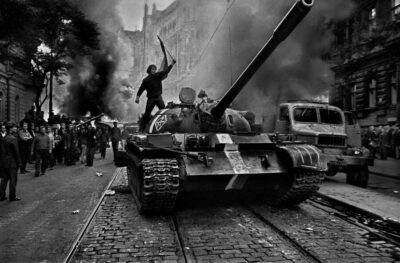
Second World War & Communism (Tip-based 3 hour tour)
Read our review →
Browse the lists this tour appears in