
Reviewed · WALKING TOURS
Private Prague Art Nouveau and Cubism Walking Tour
Prague’s medieval center gets most of the attention, but this private walk shows what happened when the city looked toward modern Europe. You’ll follow Art Nouveau curves, floral details, and theatrical interiors, then compare them with the sharp geometry of Czech Cubism. The result is a lively lesson in how architecture can reflect national pride and changing times.
I like the private format, since your guide can spend more time on the details you actually notice. I also like the mix of grand public buildings and everyday places such as Café Imperial and Lucerna Arcade. The main caution is simple: three hours on foot is a lot, and this tour is not a good match if mobility is limited.
Key points at a glance
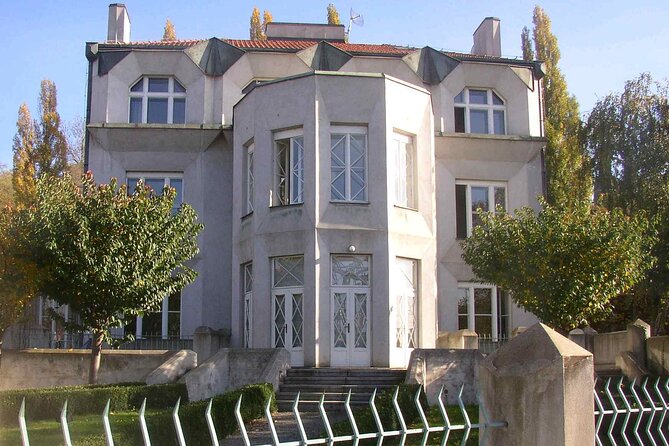
- Czech Cubism begins at the House of the Black Madonna, one of Prague’s most unusual modern buildings.
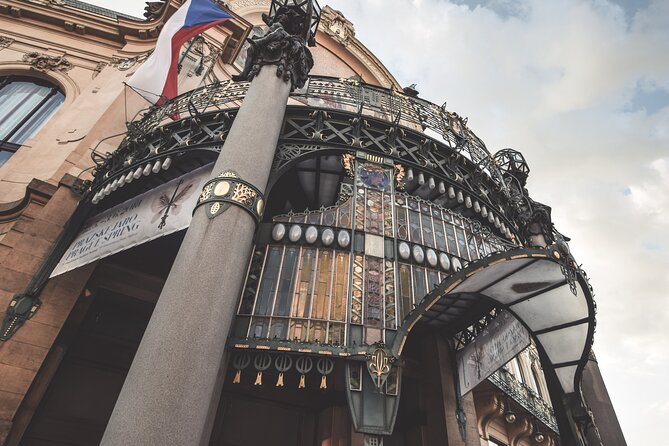
- Municipal House and Prague Main Station reveal the grand, decorative side of Art Nouveau.
- Café Imperial and Lucerna Arcade add interiors and social history, not just street façades.
- A private historian leads the walk, with guides including Robert Wesley and Bonita.
- The tour costs $396.46 for up to 10 people, making the value strongest for a full small group.
- Expect a serious city walk, with morning and afternoon departures available.
Prague’s modern face begins at the Black Madonna
The tour opens at the House of the Black Madonna, a key example of Czech Cubist architecture. You get about 10 minutes here, enough to discuss its angular design and why Cubism in Prague looks so different from the rounded lines of Art Nouveau.
This is a useful first stop because it sets up the main contrast of the tour. Art Nouveau favors flowing forms, plant motifs, decorative lettering, and soft curves. Cubism breaks those forms into hard edges and geometric planes. In Prague, these styles were not just imported fashion. They were part of a city eager to take part in new European art and design.
You may find the building more striking from the outside than the visit time suggests. The tour does not list an admission ticket, and the focus is on the architecture and its place in Prague’s cultural story.
More Private Tours in Prague
- Prague Old Town: Private Tour
★ 5.0 · 1,223 reviews - Prague Airport Private Arrival Transfer
★ 4.5 · 991 reviews - Prague Airport Private Departure Transfer
★ 4.5 · 780 reviews
Municipal House shows Art Nouveau at full volume
Next comes Municipal House, called Obecní dům in Czech. You have about 15 minutes to examine one of the city’s finest Art Nouveau landmarks.
This is where your guide can point out the style’s familiar language: ornamental surfaces, curving lines, elaborate lighting, floral decoration, and a sense that every public detail deserves design. You are not simply looking at a pretty façade. You are seeing a building that expresses confidence in Czech culture at the turn of the 20th century.
The tour’s wider theme is especially clear here. Prague was ready to move beyond old Gothic and Renaissance forms while still building a strong national identity. Art Nouveau gave architects a modern vocabulary, but it also offered plenty of room for local symbols and Czech pride.
K+K Hotel Central connects style with city change
The K+K Hotel Central Prague receives a shorter stop of about 10 minutes. It is presented as the first Art Nouveau building in Prague, which gives the guide a useful opening for explaining how the style arrived and developed in the city.
Hotel buildings are valuable stops on an architecture walk because they show how new design reached daily urban life. This was not architecture reserved for museums or government halls. Hotels, cafés, shops, and entertainment spaces all became places where people encountered new ideas about comfort, decoration, and modern living.
Look closely at the façade rather than rushing past. The tour description points to details such as gingko biloba leaves, which show Art Nouveau’s interest in forms drawn from outside the European tradition, including oriental influences. A good guide can make these small features easier to spot.
Café Imperial adds a brief indoor pause
Café Imperial gets only five minutes, but it provides a welcome change from street viewing. Its Art Nouveau interior lets you see how decorative design worked inside a public room, not just on a building’s exterior.
The short timing matters. This is an observation stop, not a scheduled meal. Food and drinks are not included, so you should not count on sitting down for a full coffee break here. Still, the café helps you imagine the social side of Prague’s new era, when architecture, posters, typography, furnishings, and public life were all changing together.
If you are especially interested in interiors, this is one of the places where you may wish for more time. The private format gives you a chance to ask questions, but the overall route has several stops to cover.
More Art Nouveau in Prague:
- Prague Art Nouveau and Cubism Walking Tour
★ 5.0 · 77 reviews - Prague Art Nouveau and Cubism Walking Tour
★ 5.0 · 29 reviews - Prague: Private Cubism & Art Nouveau Walking Tour
★ 5.0 · 15 reviews - Prague Art Nouveau Tour
★ 4.9 · 12 reviews
The Legion Bank brings Cubism into public life
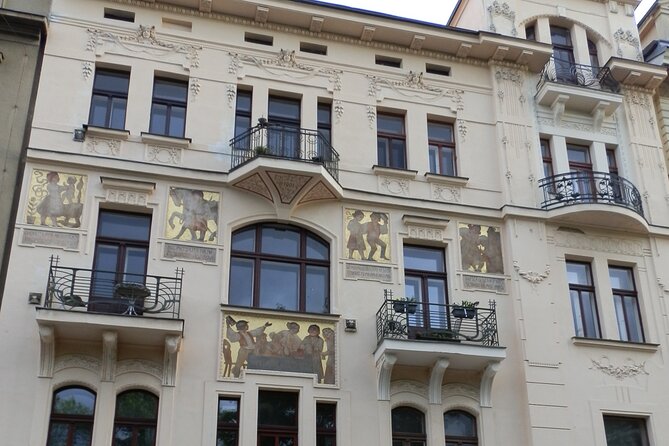
The Czechoslovak Legion Bank offers another look at Cubism, with architecture and an interior dedicated to the Czechoslovak Legion of the First World War. You spend about 10 minutes here.
This stop adds a political and national layer to the design story. The tour is not only about identifying triangles, angles, and decorative patterns. It also considers how architecture helped express the identity of a new or newly confident nation.
The bank is a good counterpoint to the softer Art Nouveau buildings earlier in the walk. You can compare the styles without needing a technical background. Your guide explains what to notice, then connects those features to Czech history and the country’s wish to take its place in modern Europe.
Prague Main Station hides a grand Art Nouveau interior
Prague’s main railway station is one of the route’s more surprising stops. From outside, a train station can seem like a place to pass through. Inside, you find a magnificent Art Nouveau dome, with about 15 minutes set aside for discussion.
Railway stations were symbols of speed, connection, and progress. That makes this a fitting stop on a tour about a city entering a new age. The building links Prague to wider Europe in a very direct way: people, ideas, goods, and design could all move through the station.
I like the practical value of this stop. You may already use Prague Main Station during your visit, and the tour gives you a reason to look up instead of simply following the signs to a platform. The station also shows that ornate architecture could serve a busy modern function.
Wenceslas Square mixes Art Nouveau with Art Deco
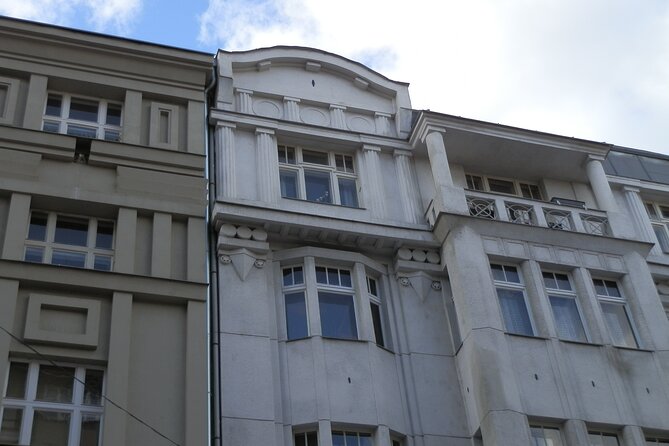
The walk continues to Wenceslas Square for about 15 minutes. Here, the guide discusses both Art Nouveau and Art Deco architecture, giving you a chance to see how styles changed over time within one major city space.
Wenceslas Square is useful because it is not a single, carefully controlled monument. It is a broad urban setting where different periods and approaches meet. You can begin to see the move from flowing Art Nouveau decoration toward the cleaner, more streamlined forms associated with Art Deco.
The square also helps place architecture in everyday Prague. It is not just a backdrop for specialists. It is part of the city’s working streets, shops, transport, public gatherings, and national memory. The guide’s job here is to make those layers readable without turning the walk into a lecture filled with technical terms.
Lucerna Arcade reveals Prague’s indoor city
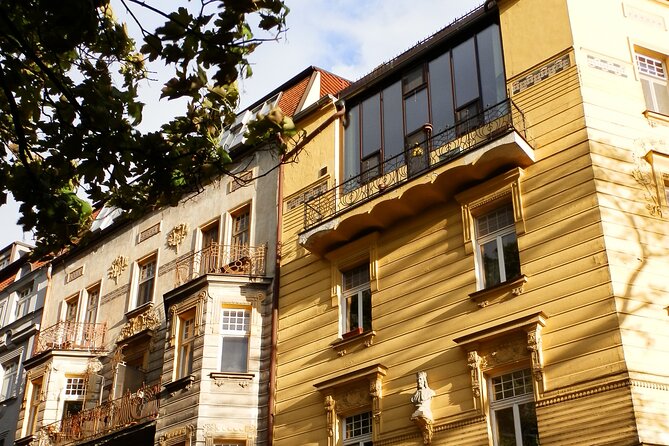
Lucerna Arcade receives about 10 minutes and is one of the route’s most appealing stops. Its Art Nouveau interior belongs to one of Prague’s most beautiful arcades, a passage where shopping, entertainment, and architecture come together.
Arcades are easy to miss if you stay on the main street. They offer a different view of the city, with decorated ceilings, interior passageways, and a more intimate sense of urban life. This is also where the tour connects with the Lucerna Bar, once owned by the family of Václav Havel.
That connection gives the design a human scale. You are not only looking at an old interior. You are considering who used these spaces, who owned them, and how they fit into the cultural life of modern Prague. The tour presents Lucerna as part of a period of Czech optimism and outward-looking ambition.
A dead horse closes the walk with a sharp modern joke
The final stop is the upside-down statue of King Wenceslas riding a dead horse. You spend about 10 minutes discussing its symbolism in the context of Czech history and the Czech National Revival.
After several hours of historic architecture, this contemporary sculpture gives the tour a pointed ending. It asks you to think about how modern artists reinterpret national symbols. The image is humorous, unsettling, and open to discussion, which makes it a better final stop than another decorative façade.
It also helps connect the old and the new. The tour begins with Prague’s early Cubist experiments and ends with a modern work commenting on Czech identity. You leave with more than a checklist of buildings. You have a clearer sense of how Prague keeps arguing with its own past.
What the private format changes
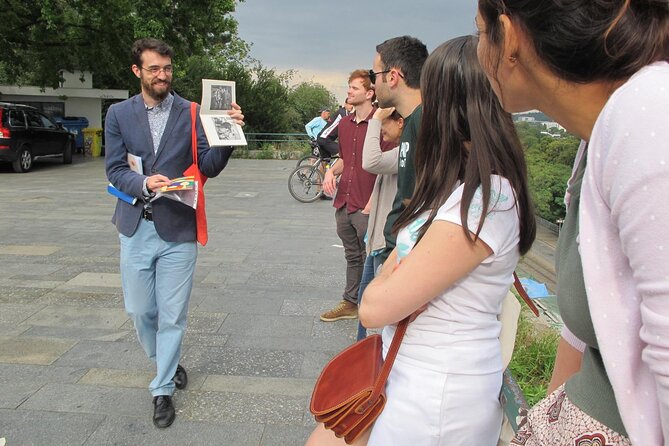
The tour is private for your group, with a maximum of 10 people. That is a meaningful difference on an architecture walk. You can ask why a particular ornament matters, request more detail about a building, or slow down briefly when a façade catches your eye.
The guides are historians, and the supplied guide information includes Robert Wesley and Bonita. Robert Wesley is Czech-born and has a Nigerian father, a personal detail that can add another layer to his stories about Prague and identity. Bonita brings together art, architecture, history, and culture in her explanations.
Guide quality matters more here than on a simple sightseeing transfer. Much of the value lies in learning how to read details: a curved letterform, a plant motif, a dome, an angular façade, or a symbol connected to Czech national feeling. The tour is strongest when you want interpretation, not just directions between famous addresses.
Price, timing, and walking effort
The cost is $396.46 per group of up to 10 people. For one or two people, that is a serious expense. For a full group, the per-person price becomes far more reasonable, especially if you value a private historian rather than a large scheduled group.
The tour lasts about three hours and offers morning or afternoon departures. It starts in central Prague and ends in Prague, with the default meeting point at Grand Café Orient on Ovocný trh 19 in Prague 1. You should arrive 15 minutes early unless a pickup has been arranged.
Pickup is offered, but hotel pickup and drop-off are not included by default. Confirm this point when booking so you know exactly where you will meet your guide. The activity is near public transportation, which makes the central starting point practical.
There are no listed admission charges for the stops, but food and drinks are not included. Plan to eat before or after the walk rather than expecting a meal during it.
The route involves a lot of walking. One person described the three hours as unsuitable for someone with limited mobility, and that is useful advice to take seriously. Even without steep climbs being specified, the length and number of stops can be tiring.
Who will get the most from this walk
I would choose this tour if you have already seen Prague Castle, Old Town Square, and the main Gothic sights, and you want a different side of the city. It also works well early in your stay if architecture is a major reason for your visit.
You do not need formal art training. The guide explains what to look for, and the route moves between enough different buildings to keep the subject concrete. You will get the most from it if you enjoy asking questions and paying attention to façades, interiors, lettering, and symbols.
This is a strong match for:
- Couples or families who want a private pace
- Small groups sharing the cost
- Visitors interested in design, architecture, or Czech culture
- People who prefer historical explanation over a quick photo stop
- Anyone curious about Prague beyond its medieval center
It is less suitable if you want a relaxed café outing, a short route, or a tour with little walking. The stops are spread across central Prague, and the three-hour schedule keeps moving.
Should you book the Prague Art Nouveau and Cubism walk?
Book it if you want to understand Prague’s turn toward modern design rather than simply photograph old buildings. The strongest parts are the contrast between Art Nouveau and Cubism, the access to interiors such as Café Imperial and Lucerna Arcade, and the chance to ask a private historian questions along the way.
The value depends heavily on group size. At $396.46, two people will pay a premium, while six to 10 people can make the cost quite sensible. Choose a morning or afternoon time that leaves room for the walk, and wear shoes suited to several hours in the city.
I would skip it only if your Prague visit is very short and you want to focus solely on medieval sights, or if a long walking route would be difficult. For everyone else, this is a smart way to see the city’s hopeful, inventive, and occasionally playful modern side.
FAQ
How long does the tour last?
The tour lasts approximately three hours.
How many people can join the private tour?
The private activity is for your group only, with up to 10 people.
Where is the default meeting point?
Unless hotel pickup has been arranged, meet your guide at Grand Café Orient, Ovocný trh 19, Prague 1. You should arrive 15 minutes before the start time.
Are morning and afternoon departures available?
Yes. You can choose a morning or afternoon departure and should advise the provider when booking.
Is hotel pickup included?
Hotel pickup is not included by default. Pickup may be offered if arranged, so confirm the details when booking.
Are food and drinks included?
No. Food and drinks are not included unless specifically stated.
Is the tour suitable for people with limited mobility?
The route involves a lot of walking and may not suit people with limited mobility. Most other participants can take part.
What is the cancellation policy?
You can cancel at least 24 hours before the local start time for a full refund. Cancellations or changes made less than 24 hours before the start time are not accepted for a refund.
More Walking Tours in Prague
- Prague: 3-Hour Walking Tour of Old Town & Prague Castle
★ 4.7 · 5,696 reviews - Prague: Ghost Walking Tour Where Legends Come To Life
★ 4.4 · 5,253 reviews - Prague: Jewish Quarter Walking Tour with Admission Tickets
★ 4.7 · 3,729 reviews - Prague Guided Walking Tour and Cruise with Authentic Czech Lunch
★ 5.0 · 3,627 reviews
Just added around Prague
- WWII and Communism History in Prague’s Old Town Private Tour★ 5.0 · 4 reviews
- World War II 4WD Tour from Prague with Lunch★ 4.4 · 3 reviews
- Wroclaw to Prague: 2-in-1 (Private Transfer + Country Tour)★ 5.0 · 4 reviews
- Prague: Historical Walking Tour with Focus on World War 2★ 4.3 · 12 reviews
- Walking tour of Prague in french: Old Town & Charles Bridge★ 4.9 · 62 reviews
- Ultimate Unlimited Beer Pong with Czech Beer★ 4.6 · 5 reviews
- Walking tour of Prague in French : Nové Město★ 4.9 · 16 reviews
- Prague: Modern Private Spa with Jacuzzi and Sauna★ 4.8 · 62 reviews
Walking Tours, compared.
3-Hour Walking Tour of Old Town & Prague Castle
Read our review →
Ghost Walking Tour Where Legends Come To Life
Read our review →
Jewish Quarter Walking Tour with Admission Tickets
Read our review →
Prague Guided Walking Tour and Cruise with Authentic Czech Lunch
Read our review →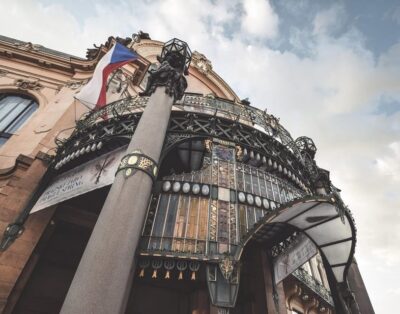
Old Town and Jewish Quarter Guided Walking Tour
Read our review →
Prague Ghost and Legend of Old Town Walking Tour
Read our review →
Prague 3-hour Afternoon Walking Tour including Prague Castle
Read our review →
Ghosts and Legends Nighttime Guided Walking Tour
Read our review →Browse the lists this tour appears in