
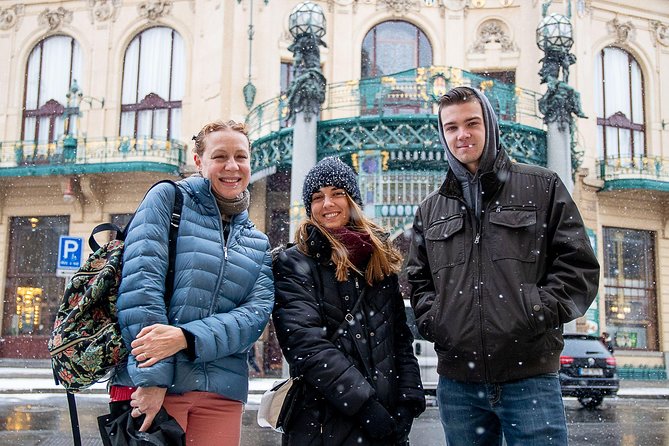
Reviewed · WALKING TOURS
Prague Art Nouveau and Cubism Walking Tour
Prague’s architecture tells a story of a city racing into modern life, then trying to define its own Czech identity. On this three-hour walk, you learn to spot Art Nouveau details such as ginkgo leaves, flowing lines, and elaborate lamps, then compare them with the sharper geometry of Cubism and Rondo-Cubism. The buildings are not just pretty façades. They reveal who had money, where people socialized, and how Prague wanted to be seen before the First World War.
I like the access to places you might pass without noticing, including the Lucerna bar and Grand Hotel Europa. I also like the teaching style: guides such as Robert, Vadim Erent, and Bonita connect architecture with politics, cafés, universities, and everyday Czech life instead of handing you a list of dates.
The main drawback is the price, $123 per person for three hours. That is a premium for a walking tour, so it makes the most sense in a private or small group, especially if architecture is a major reason you came to Prague. You should also allow some flexibility after the scheduled time if you want longer stops for photographs or conversation.
Key points to know before booking
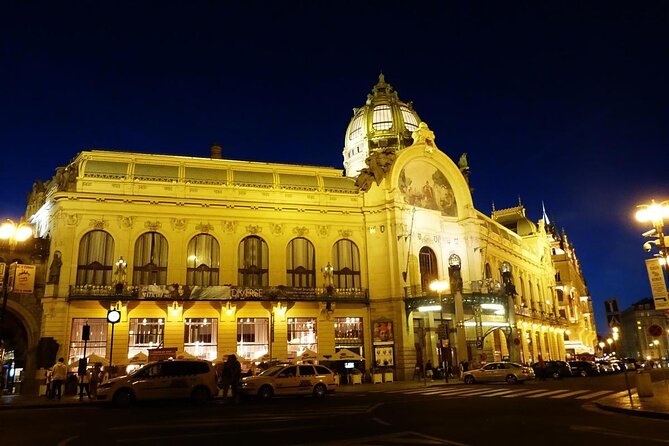
- Art Nouveau becomes easy to recognize: Learn to look for botanical patterns, curved lines, oriental influences, decorative glass, and ornate lighting.
- Lucerna and Grand Hotel Europa add interiors to the story: You are not limited to street façades and may get a useful break from cold or rain.
- Cubism gets a proper comparison: See how Prague’s House of the Black Madonna and Bank of the Legions differ from the softer Art Nouveau style.
- The guides bring academic depth: The team includes professors, doctoral students, historians, journalists, art critics, and published authors.
- The route can reveal Prague beyond the main squares: Passages, cafés, courtyards, student spaces, and less obvious interiors may form part of the walk.
- Private and small-group formats are available: This matters if you want to ask questions or spend more time with particular buildings.
Why Prague is such a good city for Art Nouveau
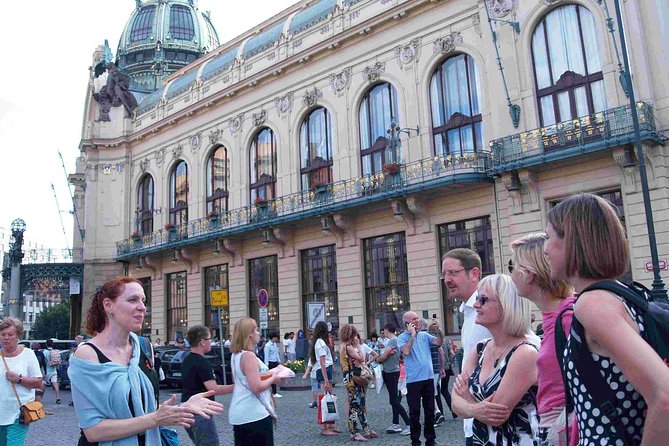
Art Nouveau arrived across Europe near the end of the 19th century, and Prague adopted it with real enthusiasm. The style suited a city entering a new age of hotels, department stores, restaurants, cafés, train stations, and public institutions.
That commercial setting matters. Art Nouveau was not built only for museums or aristocratic homes. It appeared in places where people met, spent money, traveled, and displayed their social position. The new buildings spoke to the first international tourists and to a local middle and upper class enjoying the benefits of industrial growth.
Your guide helps you read this setting. Look for plants, flowers, leaves, insects, curving ironwork, patterned glass, and elaborate lamps. Ginkgo biloba leaves are especially useful clues, since they point to the style’s interest in Asian and other non-European influences.
I like this approach because it gives you a practical skill. After the walk, you can look at a Prague façade and ask what you are seeing instead of simply deciding that it looks old or decorative. The lesson is visual, but it also explains why the style appeared when it did.
More Art Nouveau in Prague:
- Prague Art Nouveau and Cubism Walking Tour
★ 5.0 · 77 reviews - Private Prague Art Nouveau and Cubism Walking Tour
★ 5.0 · 30 reviews - Prague: Private Cubism & Art Nouveau Walking Tour
★ 5.0 · 15 reviews
Starting at the House of the Black Madonna
The tour begins at the House of the Black Madonna and Grand Café Orient, at Ovocný 19 in Prague 1. Meeting downstairs at the front doors puts you directly beside one of Prague’s best-known Cubist buildings.
This is a useful starting point because the building gives you an immediate contrast with Art Nouveau. Art Nouveau tends toward organic curves and plant forms. Czech Cubism uses stronger angles, faceted surfaces, and geometric energy. The House of the Black Madonna lets your guide explain that modern architecture in Prague was not one single movement.
The Grand Café Orient is also important to the experience. Its name and setting help connect architecture with café culture, a central part of pre-war city life. Cafés were places to read, argue, meet friends, conduct business, and take part in artistic circles. You begin to see architecture as a setting for social life rather than a collection of isolated façades.
The meeting point is central, but the cobbled streets and busy city setting mean you should arrive with a few minutes to spare. The activity is a walking tour, so comfortable shoes are more useful than polished footwear.
From Art Nouveau details to social history
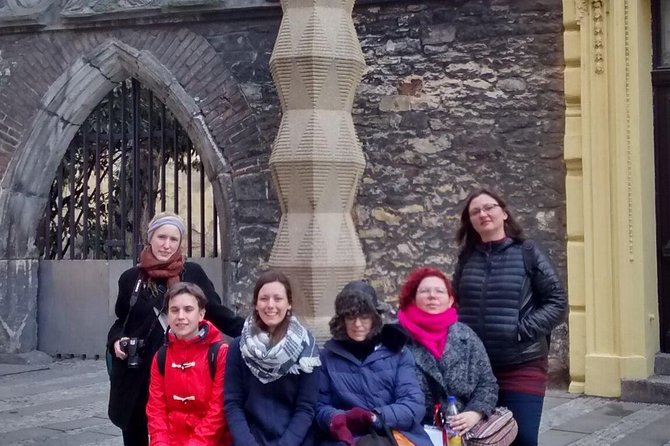
The best part of this experience is the way visual details lead into human stories. A decorative entrance is not treated as an object floating in space. Your guide explains the kind of establishment it served and the people who used it.
Hotels, restaurants, bars, and stations feature heavily because they welcomed the new mobile public. The first globetrotters were using modern transport and spending money in fashionable public places. Prague’s elegant interiors reflected that change, with grand lighting, decorative surfaces, and carefully designed rooms meant to impress.
This also explains why the period feels both optimistic and fragile. The city was enjoying new technology, new wealth, and new national confidence before war disrupted that world. The tour links architecture to a Prague that was becoming more modern while also strengthening its Czech identity.
Guides have included Robert, Vadim Erent, and Bonita. The advertised guide team includes academics, historians, journalists, art critics, and published authors. That background shows in the structure of the walk, which moves from design vocabulary to broader questions about society, nationality, and urban change.
Robert’s style, in particular, is described as clear, humorous, and highly responsive to questions. He has also adjusted the pace and included breaks when needed. That is useful for a three-hour walk, especially if your group includes people who prefer steady movement rather than long speeches on one street corner.
Inside Lucerna bar
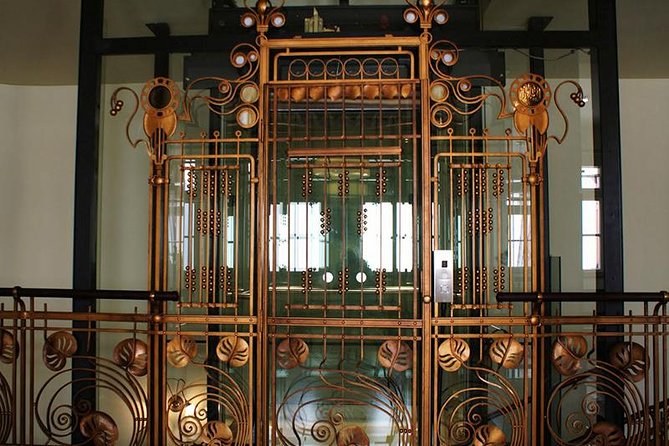
Lucerna is one of the stops that makes this more than a façade-spotting exercise. The bar gives you a chance to see how Art Nouveau worked indoors, where lighting, furniture, decorative surfaces, and room proportions combined to create a complete setting.
Pay attention to the light fixtures. They are not minor details added after the architecture was finished. In Art Nouveau interiors, lamps help create the mood and reinforce the decorative language. Your guide can point out how the shapes and materials relate to the rest of the room.
Going indoors has a practical benefit, too. Prague weather can be unkind, particularly in winter. A stop inside gives you time to warm up while continuing the discussion. One group walking in December appreciated being able to enter buildings rather than spending the full tour outside.
Access to interiors can vary by the circumstances of the day, so you should think of the listed locations as planned highlights rather than a guarantee that every room will be available for an extended visit. Still, Lucerna gives the route a welcome change of pace and helps you understand that Art Nouveau was a total design style.
More Walking Tours in Prague:
- Prague: 3-Hour Walking Tour of Old Town & Prague Castle
★ 4.7 · 5,696 reviews - Prague: Ghost Walking Tour Where Legends Come To Life
★ 4.4 · 5,253 reviews - Prague: Jewish Quarter Walking Tour with Admission Tickets
★ 4.7 · 3,729 reviews - Prague Guided Walking Tour and Cruise with Authentic Czech Lunch
★ 5.0 · 3,627 reviews
Grand Hotel Europa and the world of fashionable Prague
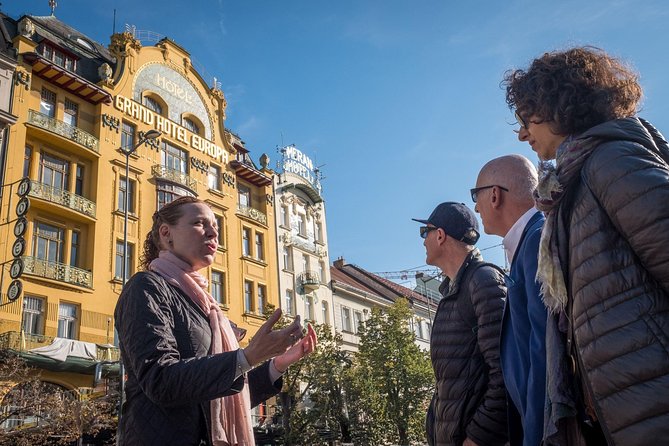
Grand Hotel Europa brings the hotel side of the story into focus. Hotels were among the most visible expressions of early 20th-century sophistication. They welcomed people arriving by rail, offered restaurants and public rooms, and gave a city a chance to present itself to outsiders.
Here, the guide can draw out the connection between architecture and status. A hotel was not merely somewhere to sleep. Its entrance, lighting, dining spaces, and ornamental details helped establish Prague as a modern European capital.
The stop also gives you a stronger sense of the social elite who filled cafés and restaurants before the war. These were the places where business, politics, art, and leisure overlapped. The architecture had a public face, but it was designed around real habits of meeting and being seen.
You should bring a camera, but do not plan on photographing every façade at leisure. The walk keeps moving, and one useful piece of advice from the experience is to take quick shots when you can. If a particular building matters to you, ask the guide for a moment before the group moves on.
Cubism, Rondo-Cubism, and a very Czech modern style
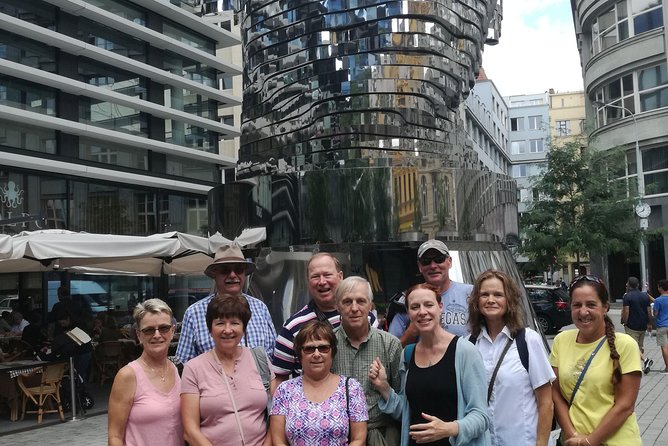
Prague is unusual in the way it embraced Cubism as architecture. In painting, Cubism is often associated with fractured forms and multiple viewpoints. In buildings, the ideas become angular façades, faceted surfaces, and bold geometric decoration.
The House of the Black Madonna is the clearest early example on this route. The Bank of the Legions helps you see a later development, often called Rondo-Cubism, with more rounded and national decorative elements. Comparing the two is far more useful than seeing either building alone.
The guide explains how these styles served more than a taste for novelty. They expressed Prague’s wish to look modern and distinct. Architecture became part of a resurgent Czech identity, particularly at a time when national culture was an important subject.
I like that the tour does not pretend Art Nouveau and Cubism are completely separate boxes. You see them as related responses to modern life, with designers borrowing, reacting, and changing direction. The visual contrast is memorable, but the political and cultural context gives it weight.
Passages, courtyards, and lesser-seen interiors
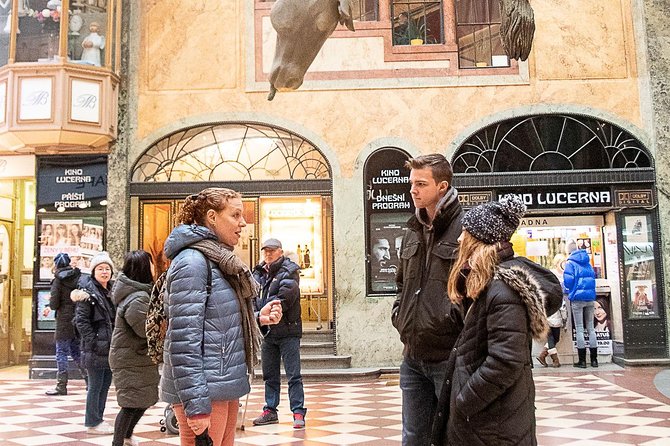
A major reason to choose a guided walk is access to places that are easy to miss when you wander alone. Prague has passages, courtyards, back entrances, cafés, and institutional spaces that do not announce their importance from the street.
The route may include student cafés, university interiors, a grand hall, an underground chapel, Roman ruins, and frescoes, depending on the guide and the day’s access. These details have appeared as part of the broader experience, but they should not be treated as fixed stops guaranteed on every departure.
This flexible quality can work in your favor. A guide who knows the city well can respond to what is open and to what interests your group. It also explains why the walk may feel less like a rigid checklist and more like a conversation through central Prague.
The tradeoff is predictability. If you want a precise minute-by-minute route with every interior guaranteed, ask about the current plan before booking. If you prefer a specialist who can show you something unexpected, the private or small-group format is likely the better choice.
Pace, group size, and the three-hour format
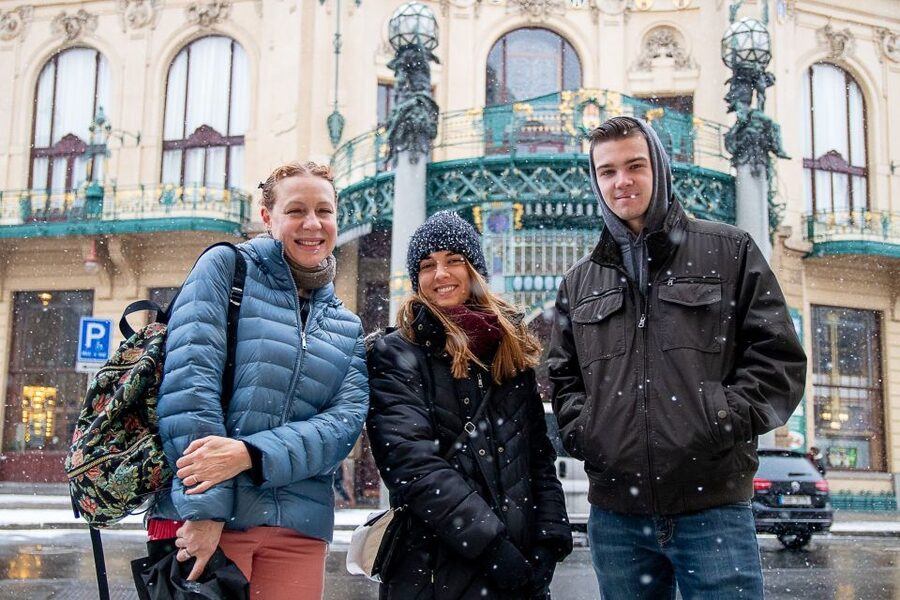
Three hours is enough time to build a proper story, but not enough to examine every building in central Prague. The guide keeps you moving, which reduces the strain of standing still for long lectures. You will still want comfortable shoes and weather-appropriate clothing.
The route includes opportunities for coffee and restroom breaks when needed. That matters because the subject can encourage long conversations, especially if you are asking about Czech politics, design, or the history of a particular building.
Private and small-group options are available. A private walk gives you more room to shape the discussion, ask about your own interests, and pause for photographs. A small group can offer much of that benefit while keeping the cost more manageable than a fully private booking.
The tour is offered in English. The guides’ academic and publishing backgrounds suggest a serious level of content, but the style is not described as stiff. Humor, clear explanations, and questions are part of the experience.
Is $123 a fair price?
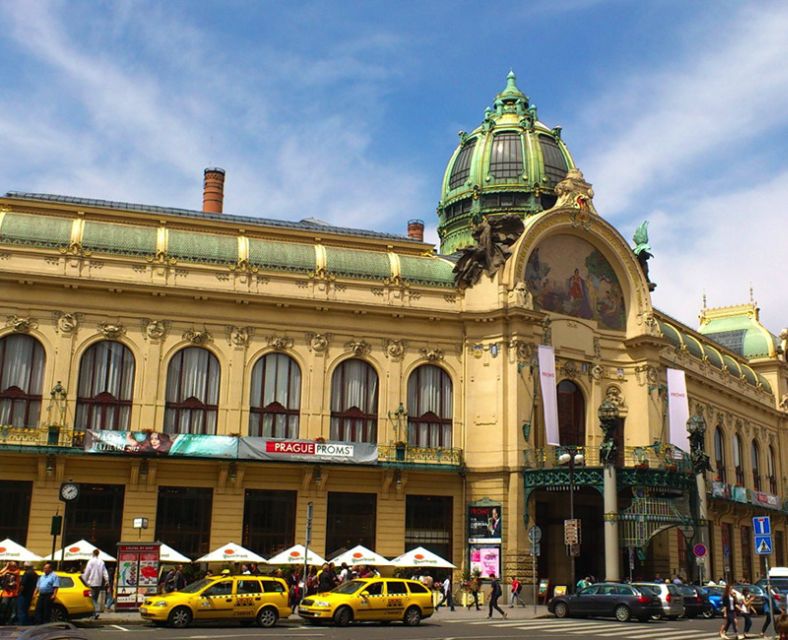
At $123 per person, this is not a bargain sightseeing walk. You are paying for a specialist-led experience, the possibility of private or small-group attention, and access to architectural context that you would not get from a general orientation tour.
The value improves if you care about architecture, design, cultural history, or photography. It also improves if you are traveling with a small party that can share the cost of a private guide. For a first visit focused mainly on Prague Castle, the Old Town Square, and basic city orientation, a less expensive general tour may be enough.
I would also consider the time saved. A guide can connect several styles across the city without requiring you to research every building in advance. You leave with a clearer eye for Art Nouveau, Cubism, and Rondo-Cubism, which can improve the rest of your sightseeing.
Free cancellation up to 24 hours before the tour and reserve-now, pay-later booking make it easier to fit into a changing schedule. Check the available start times before planning another fixed appointment, since a three-hour walk can run beyond the formal end if your group wants to continue talking.
Who should book this Prague architecture walk?
I would choose this tour if you like buildings but want more than a list of architects and dates. It suits travelers who enjoy social history, cafés, interiors, national identity, and the small clues that make a city feel specific.
It is also a strong choice for repeat visitors. If you have already seen Prague’s major sights, the passages, interiors, and architectural comparisons can give your next visit a new focus.
Families and mixed-interest groups may appreciate the steady movement and humor, though the academic subject matter will appeal most to older children and adults. Photographers should come prepared to shoot quickly and ask for extra time when a façade or interior deserves it.
You may want to skip it if you dislike walking, need a tightly timed activity, or only want the most famous postcard views. The tour’s value lies in looking closely and understanding connections, not in racing from one major monument to another.
Should you book it?
Book this walk if you want Prague to make more sense visually and historically. The strongest features are the contrast between Art Nouveau and Cubism, the attention to interiors such as Lucerna and Grand Hotel Europa, and the guides’ ability to connect architecture with cafés, social class, modernity, and Czech identity.
The $123 price calls for a clear interest in the subject. For an architecture enthusiast, a private group, or a repeat visitor, it can be a smart use of three hours. For a first-time visitor on a tight budget, choose a broader city tour first, then consider this one if Prague’s early modern buildings catch your eye.
FAQ
How long is the Prague Art Nouveau and Cubism Walking Tour?
The tour lasts three hours.
How much does the tour cost?
The listed price is $123 per person.
Where does the tour meet?
Meet at the House of the Black Madonna and Grand Café Orient, downstairs at the front doors on the square, at Ovocný 19 in Prague 1.
What language is the tour offered in?
The tour is offered in English.
Which buildings are included?
The experience includes the Lucerna bar, Grand Hotel Europa, the House of the Black Madonna, and the Bank of the Legions. Other interiors and locations may depend on the guide and access on the day.
Is the tour private or shared?
Private or small-group options are available.
Who leads the tour?
Guides include professors, doctoral students, historians, journalists, art critics, and published authors. Guides named in the experience include Robert, Vadim Erent, and Bonita.
Can I cancel the booking?
You can cancel up to 24 hours in advance for a full refund. You can also reserve now and pay later.
Just added around Prague
- WWII and Communism History in Prague’s Old Town Private Tour★ 5.0 · 4 reviews
- Wroclaw to Prague: 2-in-1 (Private Transfer + Country Tour)★ 5.0 · 4 reviews
- World War II 4WD Tour from Prague with Lunch★ 4.4 · 3 reviews
- Prague: Historical Walking Tour with Focus on World War 2★ 4.3 · 12 reviews
- Walking tour of Prague in french: Old Town & Charles Bridge★ 4.9 · 62 reviews
- Ultimate Unlimited Beer Pong with Czech Beer★ 4.6 · 5 reviews
- Walking tour of Prague in French : Nové Město★ 4.9 · 16 reviews
- Prague: Modern Private Spa with Jacuzzi and Sauna★ 4.8 · 62 reviews
Walking Tours, compared.
3-Hour Walking Tour of Old Town & Prague Castle
Read our review →
Ghost Walking Tour Where Legends Come To Life
Read our review →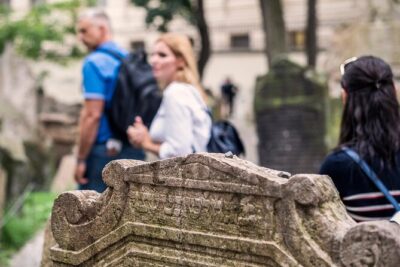
Jewish Quarter Walking Tour with Admission Tickets
Read our review →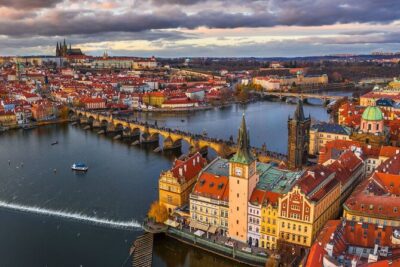
Prague Guided Walking Tour and Cruise with Authentic Czech Lunch
Read our review →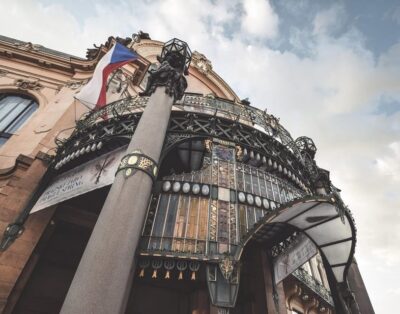
Old Town and Jewish Quarter Guided Walking Tour
Read our review →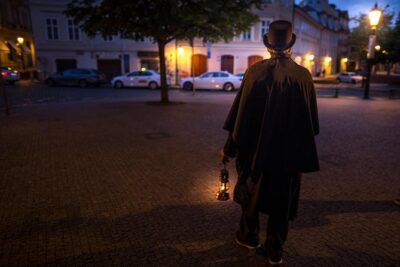
Prague Ghost and Legend of Old Town Walking Tour
Read our review →
Prague 3-hour Afternoon Walking Tour including Prague Castle
Read our review →
Ghosts and Legends Nighttime Guided Walking Tour
Read our review →Browse the lists this tour appears in