Reviewed · PRAGUE TOURS
The Plague Doctor of Prague
Prague’s plague doctor tour turns a grim subject into an engaging walk through the Old Town. You follow a costumed guide back to 1715, learning how people explained disease, survived quarantine, treated the sick, and blamed whole communities. The subject is serious, but the tone is usually light enough for families and teenagers.
I like the small group size, which makes it easier to hear the guide and ask questions. I also like the mix of public health, Jewish history, old medicine, and everyday life, rather than a simple parade of famous buildings. Guides such as Thomas, David, Oscar, Oskar, and Maddie have been praised for clear storytelling and quick humor.
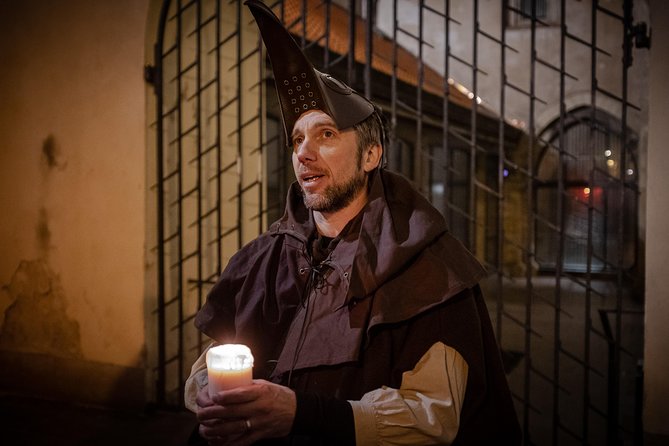
The main caution is that this is a theatrical history walk, not a specialist academic lecture. One opinion found the historical story a little thin, and the costume may need freshening up. If you want a detailed architectural tour of Prague, choose a different walk or add one beside this.
Key points to know before booking
- The tour begins at Aurus Hotel and ends near St. Agnes of Bohemia, so you do not return to the starting point.
- The 90-minute route covers plague beliefs, quarantine, medicine, Jewish life, merchants, and the Thirty Years’ War.
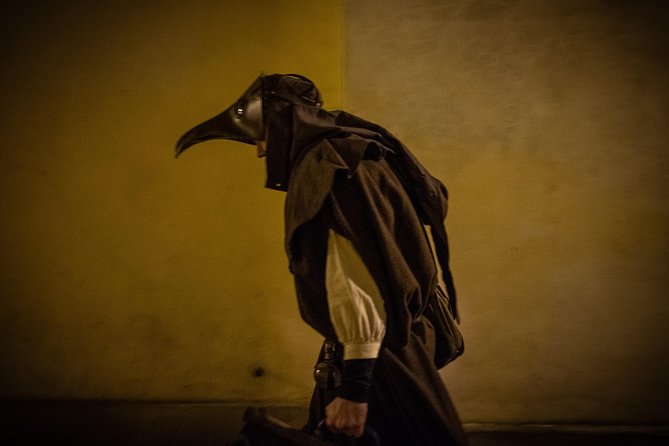
- A costumed guide stays in character, with guides including Thomas, David, Oscar, Oskar, and Maddie.
- The group limit is 10 people, a useful size for an evening walking tour.
- The tour suits adults, teens, and many children, with a balance of creepy stories, humor, and real historical detail.
- At $26.61 per person, the price is fair if you want entertainment and a guided introduction to central Prague in one outing.
Meeting Alexander Schamsky at the House of the Golden Well
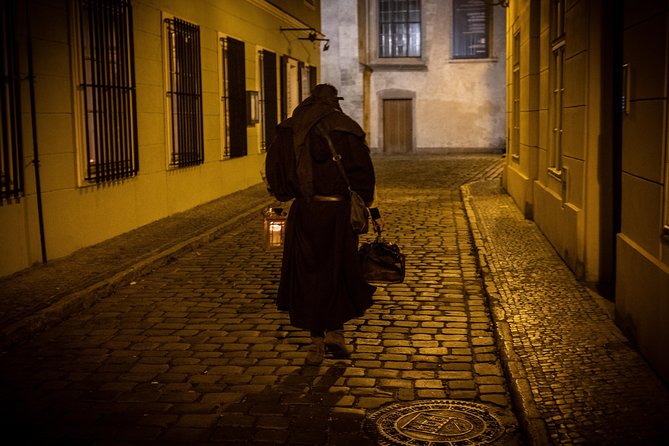
Your walk starts at Aurus Hotel on Karlova Street in Prague’s Old Town. The first ten minutes set the scene at the building also known as the House of the Golden Well, where the costumed plague doctor Alexander Schamsky is introduced.
The guide takes you back to 1715 and explains the role of St. Sebastian and St. Rochus, two saints linked with plague protection. This opening also covers the causes people once believed were behind the disease. Expect ideas shaped by religion, fear, limited medical knowledge, and the search for someone to blame.
This is a good start because it gives you the mental world of plague-era Prague. You are not just hearing that people got sick. You learn why they made the choices they did, and why some treatments and beliefs seemed reasonable at the time.
The performance matters here. The guides are not simply reading dates from a card. Thomas, David, Oscar, Oskar, and Maddie have each been praised for keeping the presentation lively and clear. The style can include dry jokes and spooky details, but the subject stays grounded in historical research.
A few more Prague half-days worth weighing up
- Prague: 50-Minute Sightseeing Evening Cruise
★ 4.2 · 33,780 reviews - Prague: Medieval Dinner with Unlimited Drinks
★ 4.4 · 19,847 reviews - Prague: Skip-the-line Castle Ticket and Optional AudioGuide
★ 4.3 · 11,121 reviews
Quarantine and class at the New Town Hall
The second stop lasts about ten minutes and brings in the Klementinum, its old monastery and library, along with the New Town Hall. The focus shifts from belief to social impact.
You hear about different forms of the Black Death and the unequal ways rich and poor people tried to escape infection. That contrast is one of the tour’s useful themes. Disease did not affect every person in the same way, even when the illness itself was widespread. Money, housing, work, and access to safer places all shaped a person’s chances.
The discussion of quarantine adds a practical link to modern public health. The guide describes what isolation meant in an earlier age, when officials had fewer tools and much less certainty. You get a sense of the disruption caused by closing doors, limiting movement, and separating sick people from family and neighbors.
The route is not a demanding hike. One hour and 30 minutes is a manageable length, especially if you have already spent the day walking Prague’s steep lanes and cobbled streets. The short stops also help keep the pace moving.
Old Town Square, merchants, and wartime Prague
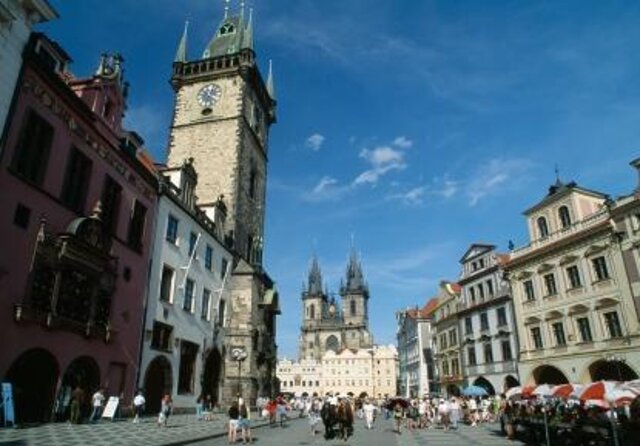
At Staromestske namesti, the tour opens onto one of Prague’s major public spaces. The guide points out the Hussite Church, Tyn Church, and Old Town Hall while explaining how merchants lived and worked during plague periods.
This stop adds an economic angle. Markets could bring people, goods, and money together, but they could also spread fear and infection. Merchants faced the loss of trade, restrictions on movement, and the risk of being treated with suspicion. The square becomes more than a photo stop. It becomes a place where public life and disease control collided.
The guide also connects the story to the Thirty Years’ War. That wider setting matters because plague did not arrive in a calm, stable world. War, movement, poverty, and crowded living conditions could all make an outbreak harder to control.
Do not expect a full tour of the churches or the Old Town Hall interiors. The architecture supports the story rather than becoming the main subject. If you want detailed information about Prague’s Gothic buildings, this section will feel brief. If you want to understand how ordinary commerce and public life changed during an epidemic, it works well.
Franz Kafka, Jewish Prague, and Albert Camus
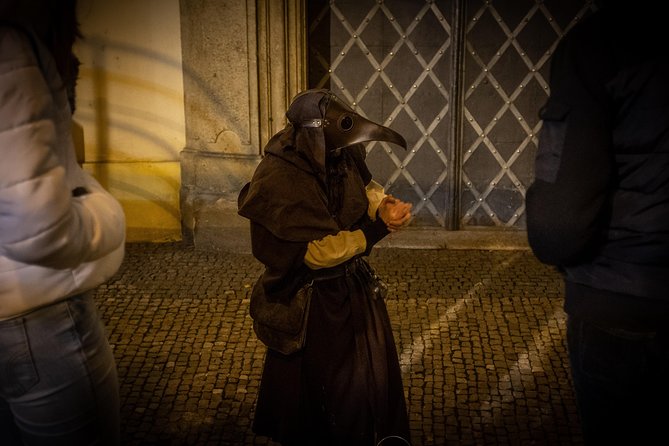
The stop at the Franz Kafka statue lasts only about five minutes, but it marks an important change in the story. After a short introduction to Kafka, the guide discusses Jewish life during plague periods in Prague and across Europe before entering the Jewish Quarter.
This section deserves attention because plague history includes not only medicine and death, but also prejudice. Jewish communities were often blamed during epidemics, and the tour places that experience within Prague’s wider story. The subject is difficult, yet it helps you see how fear can turn into persecution.
The reference to Albert Camus and his novel La Peste brings the subject into modern literature. That connection shows how plague has remained a symbol of fear, isolation, moral choice, and social breakdown long after the original outbreaks ended.
The Kafka stop is short, so do not expect a full tour of the Jewish Quarter or an extended literary discussion. Instead, treat it as a bridge between plague-era Prague, Jewish history, and later reflections on epidemic life.
A completely different way to spend a day in the same part of the country:
- Prague: Castle Tour with Local Guide and Entry Ticket
★ 4.6 · 10,422 reviews - Prague Castle 2.5-Hour Tour Including Admission Ticket
★ 4.7 · 8,927 reviews - Prague: Oldtown, Medieval Underground & Dungeon History Tour
★ 4.2 · 8,244 reviews - Prague: Vltava River Night Cruise with Buffet
★ 4.3 · 7,338 reviews
The old hospital at St. Simon and Jude
The longest stop comes at the Church of Saint Simon and Jude, where the guide introduces the former hospital Na Frantisku. This section lasts about 15 minutes and gives the tour its strongest medical focus.
You learn about healing methods used during plague outbreaks and receive basic medical background on the disease, which killed roughly 200 million people worldwide according to the tour presentation. The guide also introduces lesser-known medical workers connected with the hospital.
This part is especially suited to you if you work in medicine, study public health, or simply want more than costume and atmosphere. Several guides have clearly prepared for questions, and the presentation can include research drawn from conversations with bacteriologists and epidemic doctors.
The medical material also helps correct popular images of the plague doctor. The famous mask and robe make a striking costume, but they do not explain how disease worked or why treatment failed so often. Here, the tour moves beyond the image and into the limits of diagnosis, care, and prevention.
Some material may be unsettling. The tour deals with serious illness, death, old medical practices, and social fear. Still, the tone is designed to be approachable rather than bleak. Humor is used to keep the group engaged, not to dismiss the suffering involved.
St. Agnes of Bohemia and the final group picture
The route ends at the National Gallery’s Convent of St. Agnes, a quieter setting away from the busiest parts of the Old Town. The guide introduces St. Agnes of Bohemia, her life, and her work before drawing together the main themes of plague life in Prague and Europe.
This ending gives the walk a calmer finish. Instead of ending on a frightening medical detail, the guide returns to the larger story: how people understood disease, how communities responded, and how some of those old fears still shape public health today.
The guide also discusses the current status of the disease. That final link between past and present makes the tour more than a historical costume act. You leave with a better sense of how medical knowledge changes, while human reactions to uncertainty can remain familiar.
A group picture with the plague doctor is taken at the end. It is a small feature, but it gives the experience a clear finish and a souvenir that matches the theme. Remember that the activity ends at a different location from the start, so check your route before arranging dinner or another timed plan.
What the guides do best
The guide makes or breaks this experience. The strongest performances combine accuracy, humor, and attention to the group. Thomas has been especially effective at involving children and teenagers, speaking clearly, and staying in character. David has been praised for preparation, medical detail, and a good sense of humor. Oscar and Oskar have also been described as articulate and engaging, while Maddie brought a personal and well-prepared style.
That range matters because the tour needs two different skills. The guide must explain difficult history without turning the evening into a classroom lecture. At the same time, the guide must avoid reducing the plague to a cheap scare show.
The best moments appear to come from that balance. You might hear a creepy account of old treatment, then get a clear explanation of what people actually believed and why. Families can enjoy the performance, while adults with an interest in disease or history still get useful material.
The style is not identical every evening. A few people may want a stronger historical narrative and more content. If you need dates, sources, and a tightly ordered political history, ask questions as you go and consider pairing this with a more traditional Prague history tour.
Is $26.61 a fair price?
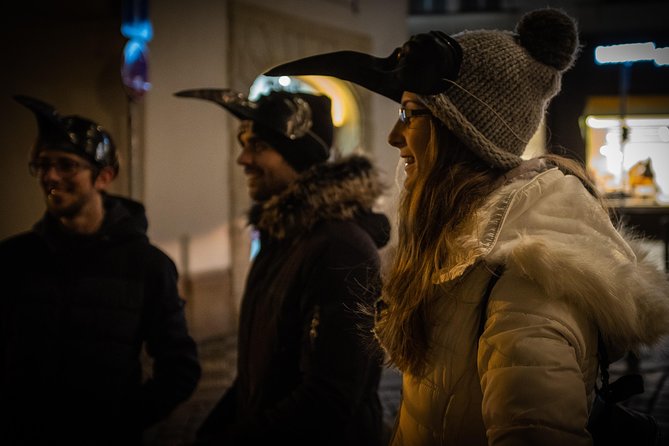
At $26.61 per person, the cost is reasonable for a 90-minute guided walk with a small group, a costumed performer, and a focused subject. You are paying for both the presentation and the setting. The tour uses central Prague streets as its stage, so you get an introduction to several parts of the city while following one connected story.
The value is strongest if you would otherwise spend the evening wandering without a plan. The route gives purpose to places such as Old Town Square, the Kafka statue, the hospital area, and St. Agnes. It also adds subjects that a standard city walk may treat only briefly, especially quarantine, Jewish communities, medical care, and everyday life during an epidemic.
The value is weaker if your main goal is architecture. Several major buildings appear along the way, but the guide uses them to explain plague-era society. You will not receive a full architectural history of the Klementinum, Tyn Church, or the Old Town Hall.
A maximum of 10 people should help keep the price worthwhile. You can hear the guide more easily than in a large group, and the guide has a better chance to respond to questions. The activity is offered in English and includes a mobile ticket.
Who should book this walk?
I would choose this tour for anyone interested in public health, medicine, social history, or unusual city walks. It is also a strong pick for families with older children and teenagers. The humorous presentation makes difficult material easier to approach, and the walking distance is suitable for most fitness levels.
It can work well as an evening activity. The route through old streets and squares gives Prague a different mood after dark, and rain may even add to the atmosphere. You should still dress for the weather because this is an outdoor walking experience.
This is less suitable for you if you dislike theatrical guides, plague imagery, or dark humor. It is also not the best single tour for a first-time visitor who wants a broad survey of Prague’s kings, churches, and political history. The subject is narrow, though the social effects reach far beyond medicine.
The experience is recognized by the New York Times, Vogue, and Forbes, and it has a 4.9 rating from 126 reviews, with 98 percent recommending it. Those figures do not replace your own judgment, but they fit the tour’s strongest qualities: good presentation, a distinctive subject, and an easy-to-manage length.
Practical details that matter
You receive booking confirmation at the time of purchase, and service animals are allowed. The starting point is Aurus Hotel Prague, Karlova 3, 110 00 Praha 1, in Stare Mesto. The tour ends elsewhere near the Convent of St. Agnes.
The experience operates in English and is close to public transportation. Most people can take part, and the stated group limit is 10. Free cancellation is available up to 24 hours before the start time. Within 24 hours, you do not receive a refund, and changes are not accepted.
The tour needs good weather and a minimum number of participants. If poor weather or low enrollment cancels the activity, you can choose another date or experience, or receive a full refund.
Should you book The Plague Doctor of Prague?
Book it if you want a memorable, well-paced look at Prague through disease, medicine, fear, and social change. I especially recommend it if your group includes teenagers, medical professionals, history fans, or people who have already seen the main sights and want a different angle.
Skip it if you want a formal lecture or a detailed architecture tour. The historical narrative can feel lighter than expected in places, and the costume may not be perfect. For most people, though, the mix of performance, serious subject matter, central Prague streets, and a small group makes $26.61 a fair evening spend.
FAQ
Where does The Plague Doctor of Prague begin?
The tour begins at Aurus Hotel Prague, Karlova 3, 110 00 Praha 1, in Prague’s Old Town.
Where does the tour end?
The activity ends at a different location from the starting point, at the National Gallery Prague, Convent of St. Agnes area.
How long does the tour last?
The tour lasts approximately one hour and 30 minutes.
What language is the tour offered in?
The tour is offered in English.
How much does the tour cost?
The listed price is $26.61 per person.
How many people can join the tour?
The activity has a maximum group size of 10 people.
Is the tour suitable for children?
Most people can participate, and the experience has been enjoyed by adults, teenagers, and children. The presentation includes creepy stories and dark historical subjects, so consider your child’s comfort with plague and death-related material.
Is the tour accessible by public transportation?
The tour is near public transportation. The stated information does not specify a particular station or route.
Can I cancel for a full refund?
Yes. You can cancel at least 24 hours before the start time for a full refund. Cancellations or changes made less than 24 hours before the start time are not refunded or accepted.
Just added around Prague
- WWII and Communism History in Prague’s Old Town Private Tour★ 5.0 · 4 reviews
- World War II 4WD Tour from Prague with Lunch★ 4.4 · 3 reviews
- Wroclaw to Prague: 2-in-1 (Private Transfer + Country Tour)★ 5.0 · 4 reviews
- Prague: Historical Walking Tour with Focus on World War 2★ 4.3 · 12 reviews
- Walking tour of Prague in french: Old Town & Charles Bridge★ 4.9 · 62 reviews
- Ultimate Unlimited Beer Pong with Czech Beer★ 4.6 · 5 reviews
- Walking tour of Prague in French : Nové Město★ 4.9 · 16 reviews
- Unique salt cave in Prague★ 4.9 · 10 reviews
Prague Tours, compared.

Skip-the-line Castle Ticket and Optional AudioGuide
Read our review →
Castle Tour with Local Guide and Entry Ticket
Read our review →
Prague Castle 2.5-Hour Tour Including Admission Ticket
Read our review →
Oldtown, Medieval Underground & Dungeon History Tour
Read our review →