
Reviewed · PRAGUE CASTLE TOURS
Prague Castle St. Vitus Cathedral, Royal Palace, St. George’s Basilica
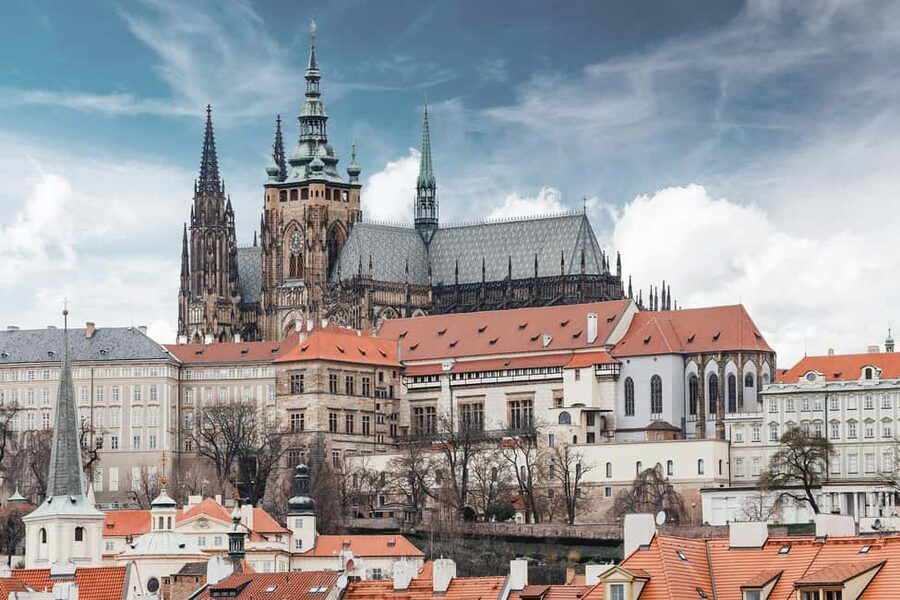
Prague Castle is not just one grand building. It is a whole walled world of cathedrals, royal rooms, old churches, narrow lanes, and sweeping views across Prague. This three-hour tour takes you through its best-known interiors, from the Gothic glory of St. Vitus Cathedral to the tiny homes of Golden Lane.
I like the clear route and the help of historian Robert Procházka, who leads the tour in German and adds historical stories along the way. I also like that the ticket purchase is handled with the guide at a special guide counter, which should save you from a long wait. The main drawback is cost: the $41 tour fee does not include the castle admission ticket, which adds 18 EUR for adults or 14 EUR for seniors.
Key points to know before you book
- A three-hour German tour with historian Robert Procházka: You get guided context rather than simply walking through the castle on your own.
- Four major castle sights in one visit: The route includes St. Vitus Cathedral, the Old Royal Palace, St. George’s Basilica, and Golden Lane.
- A separate admission fee applies: Adults pay 18 EUR, while seniors aged 65 and over pay 14 EUR.
- Meet at the Pražský hrad tram stop: Tram lines 22 and 23 stop there in the direction of Bílá hora.
- The tour suits adults and older children: Children under 10 are not permitted.
- Expect stories as well as architecture: The tour covers saints, coronations, royal power struggles, alchemy, and Franz Kafka.
Starting at Prague Castle’s Pražský hrad tram stop
Your meeting point is the Pražský hrad stop, served by tram lines 22 and 23 in the direction of Bílá hora. This is a practical place to begin because Prague Castle sits on a large hilltop complex, and arriving by tram avoids an uphill walk from the lower city.
Look for Robert Procházka at the stop. The meeting point is specific, so take a moment to confirm that you are at Pražský hrad rather than another nearby stop. Prague Castle has several entrances and courtyards, and starting with the guide keeps you from wasting time trying to find the right interior route.
The tour lasts three hours. That is long enough to see the principal paid sights without turning the visit into an all-day march. You should still expect plenty of walking and standing. The castle grounds are extensive, and each building has its own entrance areas, stairs, and courtyards.
The tour is conducted in German only. That is a major reason to book it if German is the language in which you prefer to hear history explained. If you do not understand German comfortably, you will get far more from an English-language option elsewhere.
More Castle Tours in Prague
- Prague: Skip-the-line Castle Ticket and Optional AudioGuide
★ 4.3 · 11,121 reviews - Prague: Castle Tour with Local Guide and Entry Ticket
★ 4.6 · 10,422 reviews - Prague Castle 2.5-Hour Tour Including Admission Ticket
★ 4.7 · 8,927 reviews
St. Vitus Cathedral and the story of Bohemian kings
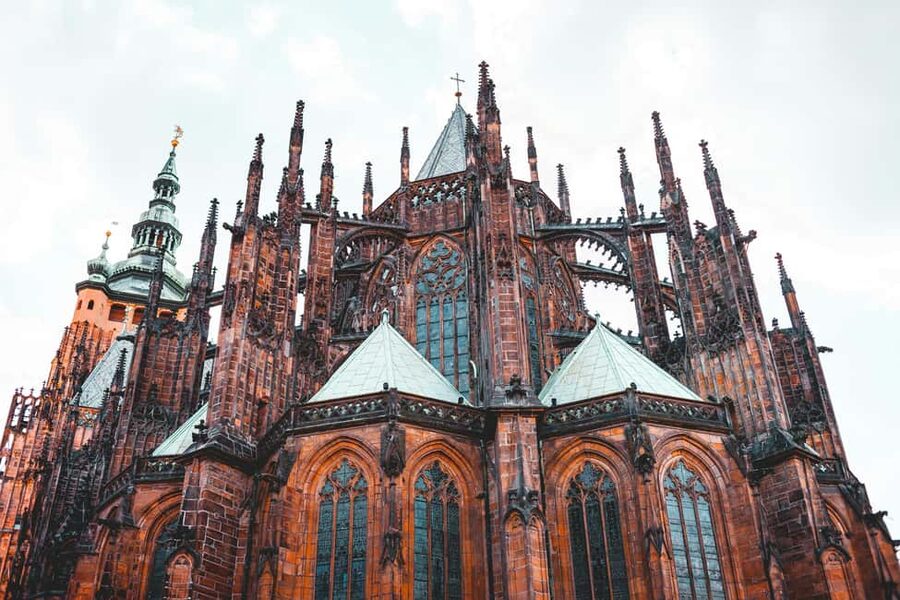
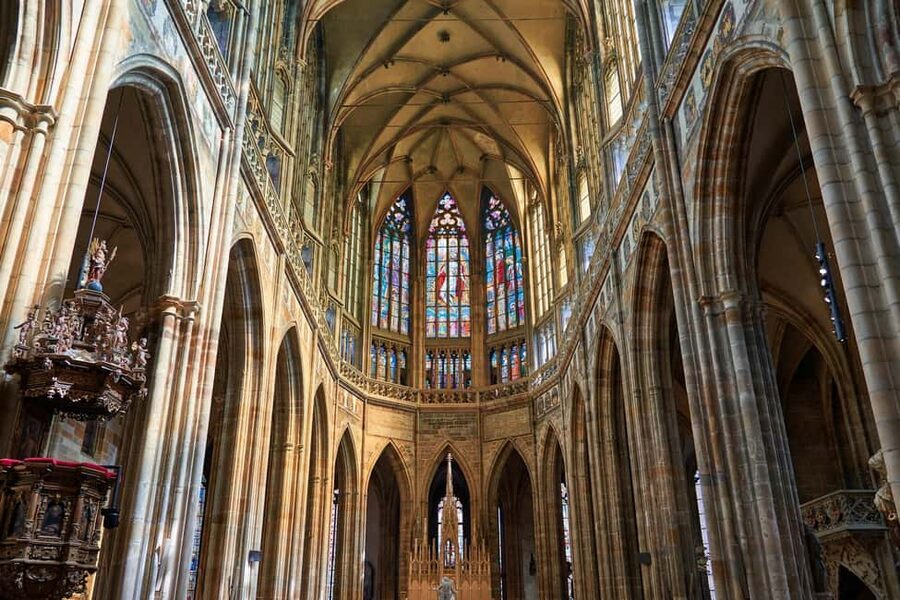
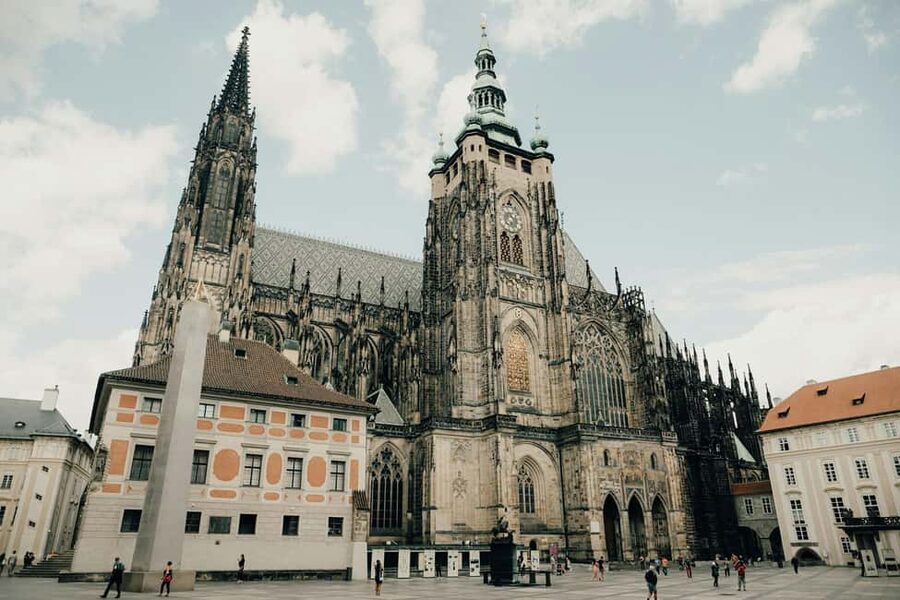
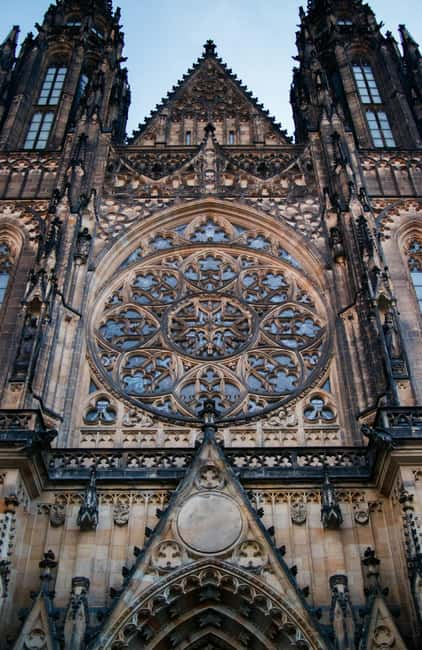
St. Vitus Cathedral is the grand centerpiece of the visit. Its Gothic form gives Prague Castle much of its drama, but the building also carries the religious and political story of Bohemia.
The cathedral’s oldest predecessor was a Romanesque rotunda founded around 925. The present Gothic church developed later and became the burial and coronation church of Bohemian kings. This is one of the places where royal ceremony and religious tradition meet in a very direct way.
Inside, you will hear about important Bohemian saints, including St. Wenceslas and St. Adalbert. Their presence helps explain why the cathedral is more than a handsome old church. It is a national shrine, a royal burial place, and a record of changing architectural taste.
The St. Wenceslas Chapel is one of the most striking parts of the visit. It is decorated with semi-precious stones, and the remains of St. Wenceslas rest in a Gothic shrine there. A spiral staircase leads toward the crown chamber, where the coronation regalia are kept.
The crown chamber itself is not simply an ordinary gallery. Its connection with the Bohemian crown jewels gives the cathedral a sense of state power, even when the objects are not on display. Ask Robert to clarify what you can see during your visit, since access to individual areas can depend on the day’s arrangements.
I like having a historian explain the cathedral here. Without context, it is easy to spend your time looking upward at the vaults and windows while missing why the building mattered to Czech rulers. The tour gives you a reason to look at the chapel, tombs, and ceremonial spaces with more care.
The Old Royal Palace and Prague’s dangerous politics
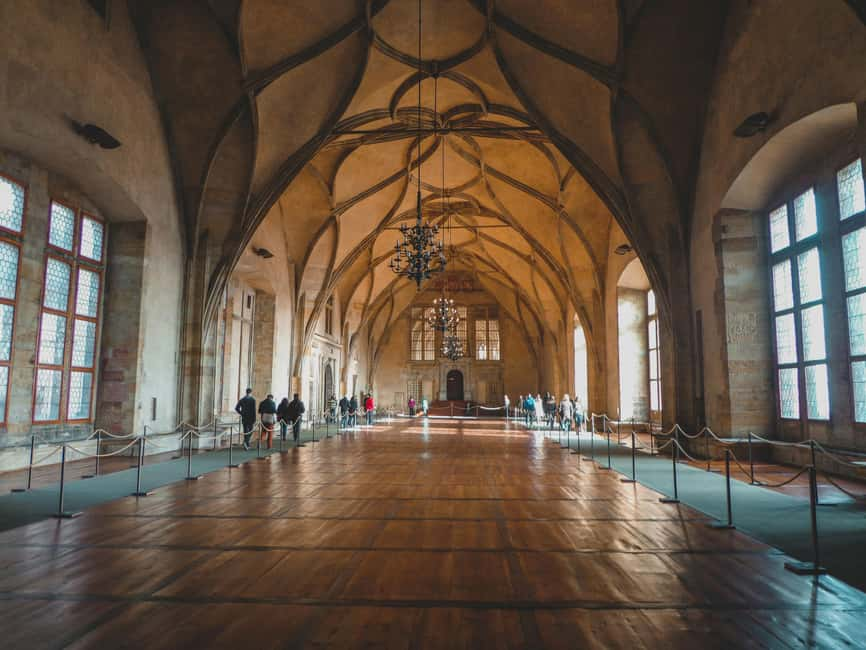
The Old Royal Palace shifts the focus from worship to government. Here you see the largest late Gothic throne room in Central Europe, along with the State Chancellery, the site of Prague’s Third Defenestration.
The word defenestration means throwing someone out of a window. In Prague’s political history, it is not a joke but a recurring method of settling serious disputes. The Third Defenestration helped begin the Thirty Years’ War, one of Europe’s major religious and political conflicts.
That story gives the palace real force. You are not just passing through an old government building. You are standing in a room linked to a crisis that spread well beyond Bohemia.
The late Gothic throne room is another major stop. Its size helps you picture the scale of medieval and early modern court life. A room built for ceremony tells you how rulers wanted to be seen: elevated, formal, and surrounded by authority.
You can also see a replica of the Bohemian crown jewels. The replica is useful because it allows you to understand the shape and symbolism of the regalia without confusing a reconstruction with the original objects. The actual crown jewels are kept in the cathedral’s crown chamber.
This is one of the most valuable parts of the route for visitors who want more than architectural detail. Robert’s historical explanations can connect the rooms to political events, giving the palace a sharper sense of purpose.
St. George’s Basilica and an older Prague
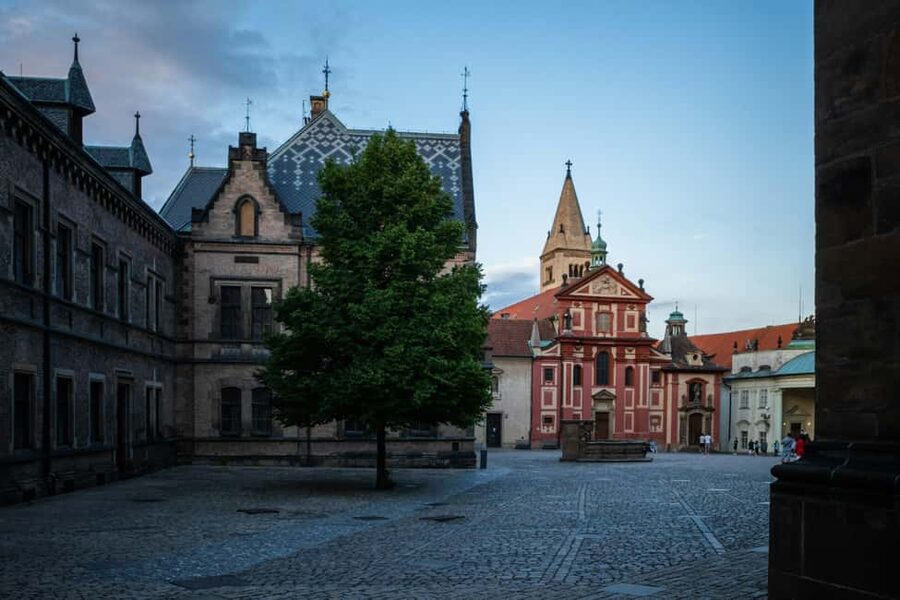
St. George’s Basilica dates from the 10th century and offers a change of mood after the scale of the cathedral and palace. Its earlier Romanesque character helps you see that Prague Castle was built in layers over many centuries.
The basilica contains the tomb of St. Ludmila, the grandmother of St. Wenceslas. Her story is grim. She was strangled to death by Viking warriors acting on behalf of her daughter-in-law.
That tale may sound startling beside the calm church interior, but it fits the hard political and religious world of early medieval rulers. Saints in this setting were not distant figures. Their family ties, deaths, and rivalries were tangled with the formation of the Bohemian state.
I find this stop useful because it prevents the castle visit from becoming a parade of grand rooms. St. George’s Basilica is smaller and older, and its history adds a human edge to the royal story.
The building also helps you compare styles. St. Vitus shows the soaring ambition of Gothic architecture, while St. George’s reflects an earlier Romanesque tradition. Across the tour, you will encounter Gothic, Renaissance, and Baroque influences, often within a fairly compact area.
More Church Tours in Prague
- Prague: Entry Ticket Classical Concert at the Mirror Chapel
★ 4.7 · 4,636 reviews - Prague: A. Vivaldi Four Seasons at St. Salvator Church
★ 4.4 · 1,951 reviews - Prague: Classical Concert in St. Nicholas Church
★ 4.3 · 513 reviews - Prague: Mirror Chapel Classical Music Concert Ticket
★ 4.8 · 295 reviews
Golden Lane, alchemy, and Franz Kafka
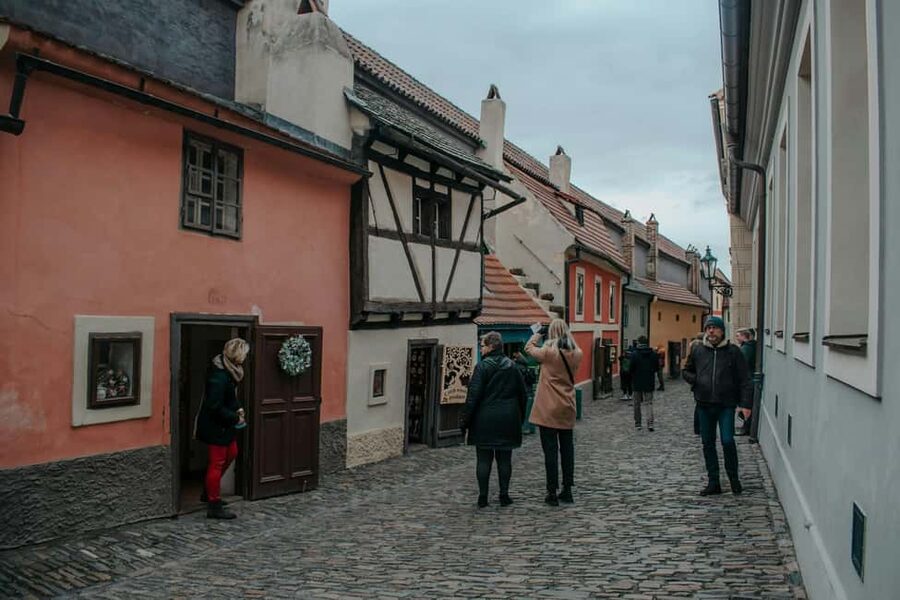
The tour ends in Golden Lane, one of the most picturesque parts of Prague Castle. Its tiny, colorful houses create a sharp contrast with the cathedral and throne room.
Golden Lane takes you back to the 16th century. The lane is linked with the alchemists of Emperor Rudolf II, who searched for an elixir of life and tried to turn lead into gold. The stories mix science, superstition, royal ambition, and the desire to control nature.
You will also hear about Franz Kafka, the famous Prague writer who lived in one of the small houses. His connection gives the lane a literary link as well as a historical one.
The houses are small enough to make the royal complex feel surprisingly personal. After visiting ceremonial rooms built for kings, you see spaces associated with craftsmen, servants, experimenters, or writers. That contrast is part of the lane’s appeal.
Golden Lane can be the most immediately charming stop, but it may also feel more tourist-oriented than the cathedral or basilica. Its narrow passage and compact rooms are memorable, yet you should not expect a quiet residential street. The value comes from understanding how this little lane fits into the castle’s larger story.
The supplied details describe the guided visit as ending in Golden Lane. The meeting information also says the activity ends back at the original meeting point, so confirm the exact end location when you book or meet Robert. Either way, you will want to know where you are going next before the tour finishes.
The castle views are part of the experience
Prague Castle offers broad views over the city, and the high position is one of the tour’s rewards. You can look across Prague from the castle grounds and see why this site held such power for rulers.
The views also make the castle easier to understand geographically. The complex is not isolated from Prague. It overlooks the city and forms one of its most recognizable landmarks.
The castle grounds are described as the largest enclosed castle grounds in the world and are listed in the Guinness Book. The exact claim is less important to your visit than the practical point behind it: this is a very large complex, not a single museum room that you can finish in half an hour.
That scale makes a guide useful. You can wander on your own, but it is easy to lose the thread between the cathedral, palace, basilica, and lane. A fixed route lets you see the major sights in a sensible order and spend your time listening rather than navigating.
What the $41 price really covers
The $41 price pays for the three-hour guided service with Robert Procházka. It does not include admission to the four main sights.
You must also pay 18 EUR for an adult ticket or 14 EUR if you are at least 65 years old. Robert accompanies you to the castle ticket office, where you can pay by card. You can also hand him the amount in euros, and he will obtain the ticket for you.
The guide uses a counter reserved for guides, so you should not have to wait in the standard ticket line. That small convenience matters at a busy complex, especially when your tour already has a fixed start time.
Is the combined cost good value? I think it can be, if you want historical explanation in German and prefer a planned visit to four important sights. The guide fee is not an all-inclusive entry ticket, so compare the total cost with a self-guided visit before booking.
You should also allow for exchange-rate changes because the tour price is listed in dollars while the castle admission is charged in euros. Seniors receive a lower admission price, but the guided-tour fee remains the same.
Who will get the most from this tour
This experience is a good match for you if German is your preferred tour language and you want the major Prague Castle sights explained by a historian. It is also useful if you value a direct route and want help with the ticket purchase.
The tour suits adults and children aged 10 or older. The subject matter is serious at times, especially the stories of political violence, royal conflict, and St. Ludmila’s death. Families with younger children will need another option.
You should choose a self-guided visit instead if you want to linger for a long time in one building, set your own pace, or avoid paying for a guide. Three hours gives the tour a firm rhythm. That is helpful for some people, but it leaves less room for extended photography or repeated visits to favorite rooms.
The strongest feature is the storytelling. The route includes architecture from several periods, but the saints, kings, alchemists, political rebels, and Kafka connections give the buildings a human scale. The positive feedback attached to the experience emphasizes plenty of information and pleasant stories, which is exactly what this tour is designed to provide.
Should you book Prague Castle with Robert Procházka?
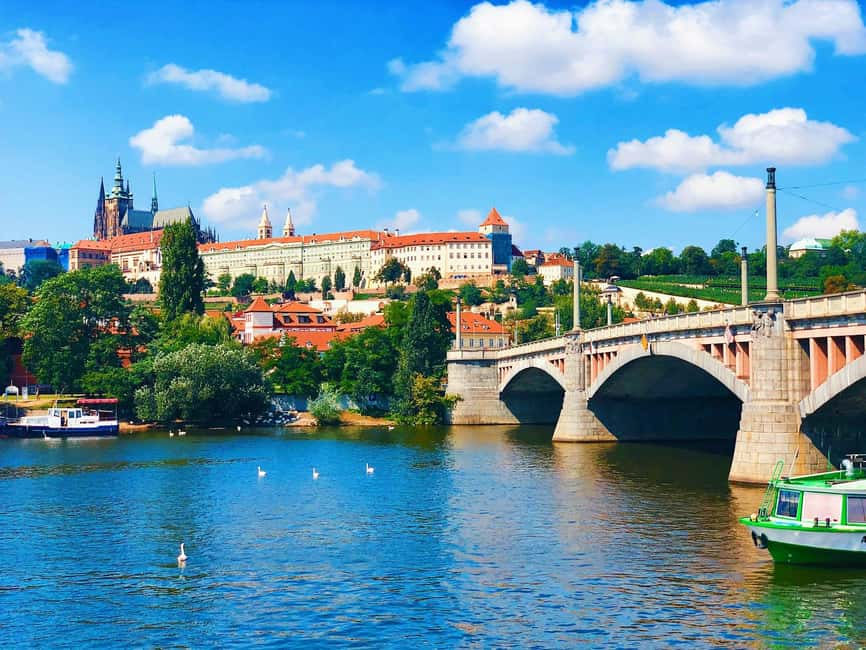
Book it if you want a focused three-hour introduction to Prague Castle in German, with St. Vitus Cathedral, the Old Royal Palace, St. George’s Basilica, and Golden Lane all included. Robert Procházka’s historian-led approach should help you connect the buildings to Czech royal, religious, and literary history.
Think twice if the extra 18 EUR admission charge changes your budget, if you need English, or if you prefer to explore at your own speed. For German-speaking adults who want the castle’s big sights and memorable stories in one organized visit, the tour offers a practical way to get oriented without losing the meaning behind the stonework.
FAQ
How long does the Prague Castle tour last?
The guided tour lasts three hours.
What language is the tour conducted in?
The tour is conducted in German.
Who guides the experience?
Historian Robert Procházka guides the tour.
Where does the tour begin?
The meeting point is at the Pražský hrad tram stop, also called Prague Castle stop. Tram lines 22 and 23 serve the stop in the direction of Bílá hora.
Which Prague Castle sights are included?
The route includes St. Vitus Cathedral, the Old Royal Palace, St. George’s Basilica, and Golden Lane.
Is the castle admission ticket included in the $41 price?
No. Admission costs 18 EUR for adults and 14 EUR for seniors aged 65 and over.
Can children join the tour?
Children under 10 are not permitted to join the activity.
More Ways Into Prague Castle
- Prague: 3-Hour Walking Tour of Old Town & Prague Castle
★ 4.7 · 5,696 reviews - Prague: 3-Hour Old Town and Prague Castle Tour in German
★ 4.8 · 5,671 reviews - Prague: Prague Castle and Lobkowicz Palace Entry Tickets
★ 4.4 · 5,066 reviews - Prague 3-hour Afternoon Walking Tour including Prague Castle
★ 5.0 · 1,899 reviews
Just added around Prague
- WWII and Communism History in Prague’s Old Town Private Tour★ 5.0 · 4 reviews
- World War II 4WD Tour from Prague with Lunch★ 4.4 · 3 reviews
- Wroclaw to Prague: 2-in-1 (Private Transfer + Country Tour)★ 5.0 · 4 reviews
- Prague: Historical Walking Tour with Focus on World War 2★ 4.3 · 12 reviews
- Walking tour of Prague in french: Old Town & Charles Bridge★ 4.9 · 62 reviews
- Ultimate Unlimited Beer Pong with Czech Beer★ 4.6 · 5 reviews
- Walking tour of Prague in French : Nové Město★ 4.9 · 16 reviews
- Prague: Modern Private Spa with Jacuzzi and Sauna★ 4.8 · 62 reviews
Prague Castle Tours, compared.

Prague Castle 2.5-Hour Tour Including Admission Ticket
Read our review →
3-Hour Walking Tour of Old Town & Prague Castle
Read our review →
Prague Castle and Lobkowicz Palace Entry Tickets
Read our review →
Prague 3-hour Afternoon Walking Tour including Prague Castle
Read our review →
Prague Castle: Midday Classical Concert at Lobkowicz Palace
Read our review →
Full-Day Prague Tour with Prague Castle, Lunch and Vltava Cruise
Read our review →
Prague Castle & Castle District: 2-Hour Guided Tour
Read our review →
Prague Castle: Small-Group Tour with Visit to Interiors
Read our review →Browse the lists this tour appears in