
Reviewed · OLD TOWN TOURS
Prague Old Town: Private Tour
Prague reveals its best stories on foot, and this private tour packs the city’s central sights into a useful two-and-a-half-hour introduction. You begin at the Powder Tower, pass through Old Town’s grand squares and old lanes, then reach the Jewish Quarter before finishing near Charles Bridge. It is a brisk route, but it gives you a clear map of Prague’s past.
I like the private format, since your group can ask questions and set the pace instead of following a large crowd. I also like the range of subjects, from Cubist design and Mozart to Jewish Prague and the Astronomical Clock. The main consideration is simple: this is a history-focused walking tour, so you need moderate fitness and comfortable shoes.
Key points at a glance
- Starts at the Powder Tower: A central meeting point near public transportation and one of Prague’s best-known Gothic entrances.
- Covers major Old Town sights: See Týn Church, Saint Nicholas Church, Jan Hus, Charles University, and the Astronomical Clock.
- Adds the Jewish Quarter: The route includes the synagogues, Jewish Town Hall, Ceremonial Hall, and Old Jewish Cemetery.
- Private guiding matters: Only your group participates, making it easier to ask questions or request more attention to politics, architecture, religion, or culture.
- Ends by Charles Bridge: The finish puts you in a handy spot for continuing toward Malá Strana or the river.
- Strong track record: The experience is recommended by 99 percent of customers and has a five-star rating from 1,223 reviews.
Why this route works for a first look at Prague
Prague’s center is compact, but its story is not. Gothic churches, Baroque facades, medieval institutions, Jewish landmarks, modern political history, and famous composers all sit within a short walk. A good guide helps you connect those pieces instead of seeing them as a string of pretty buildings.
This route does that in a sensible order. You start at the Powder Tower, one of the old gates into Prague’s historic center, then move toward the Old Town landmarks before heading into the Jewish Quarter. The tour finishes near Charles Bridge, so you end in one of the city’s most useful locations rather than returning to the starting point.
The private setup changes the feel of the walk. You are not simply listening to a fixed speech. Guides such as Iva, Tereza, Tony, and Via are praised for answering questions, adjusting the pace, and making complex political and cultural subjects easier to follow. That flexibility is especially useful if your group includes children, older adults, or people with different levels of interest in history.
At $54.42 per person, the price is fair if your group values personal attention. It is not the cheapest way to see Prague, but it is a reasonable price for a private English-speaking guide covering this much ground. The value is strongest for two or more people who want conversation and context, rather than a basic orientation walk.
More Private Tours in Prague
- Prague Airport Private Arrival Transfer
★ 4.5 · 991 reviews - Prague Airport Private Departure Transfer
★ 4.5 · 780 reviews - Discover Prague Private Tour – 3 hours
★ 5.0 · 705 reviews
Meeting the guide at the Powder Tower
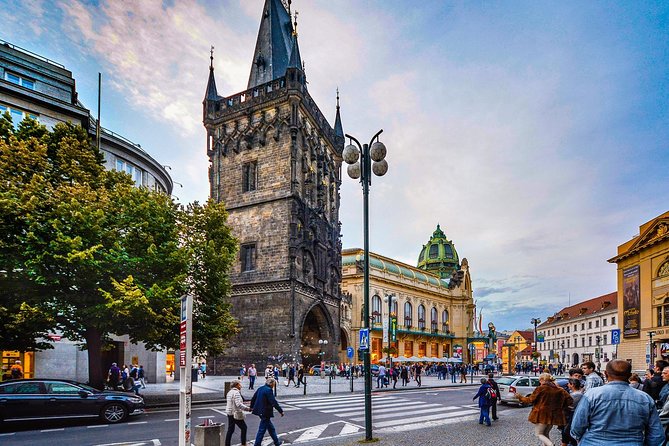
The tour begins at the Powder Tower on Náměstí Republiky, at Nám. Republiky 5 in Staré Město. This is a practical place to start because it is near public transportation and already puts you at the edge of Prague’s historic center.
Arrive ready to walk. The tour is not a museum visit with long indoor stops. It is an outdoor route through streets and squares, with the guide explaining what you are seeing along the way. Since the end is usually by Charles Bridge, you should not expect to return to the Powder Tower.
The meeting point also gives the guide a natural way to explain how Prague developed. The Powder Tower marks the transition from the newer parts of central Prague into the Old Town. From here, the route moves into an area where architecture from several periods appears close together.
Cubist Prague and the city’s unusual architecture
One early stop is the first Cubist building in Prague. This is a useful reminder that the city is not only about medieval towers and ornate churches. Prague also played an important role in modern design, and Cubist architecture gives the walking tour a sharper, more unexpected edge.
The stop is likely to appeal to anyone who enjoys buildings as much as historical events. Your guide can help you notice the shapes and design choices rather than walking past the building as just another facade. This is one place where a guided walk earns its keep: the architecture may be easy to miss if you do not know what you are looking for.
The route does not focus only on one style. You move from this modern architectural landmark toward older institutions and churches, giving you a quick lesson in how Prague changed over time.
Mozart, theatre, and Prague’s musical past
The tour includes Prague’s oldest theatre, famous for Mozart. That detail adds a cultural layer beyond kings, battles, and church architecture. It also shows how Prague fit into the wider artistic life of Europe.
The Mozart connection is especially useful for visitors who know the city through music rather than politics. Your guide can place the theatre in the context of Prague’s cultural life and explain why the building remains important. The stop is not presented as a separate concert or performance, so expect an exterior explanation rather than a theatre production.
This is one of several short stops where the guide has to condense a large subject. That can be a benefit, since you get a broad view without spending your entire day on one building. The tradeoff is that anyone wanting detailed architectural or musical study will need more time afterward.
More Old Town walks in Prague:
- Prague: Old Town Hall Tower Entry Ticket
★ 4.5 · 6,749 reviews - Prague: 3-Hour Walking Tour of Old Town & Prague Castle
★ 4.7 · 5,696 reviews - Prague: 3-Hour Old Town and Prague Castle Tour in German
★ 4.8 · 5,671 reviews - Prague Old Town, Medieval Underground and Dungeon Historical Tour
★ 4.5 · 3,227 reviews
Charles University and the making of a city
The route passes the oldest university in Central Europe, founded in 1348 by Charles IV. This stop helps explain why Prague became an important center of learning and power.
The university also provides a useful bridge between medieval Prague and the city’s later political story. One particularly praised feature of the guiding is the way historical events are linked to more recent ones, so the past does not feel sealed off from modern life. That approach can make the city easier to understand, especially if you are new to Czech history.
The guide’s role here is important. Dates alone are easy to forget. A clear explanation of why the university mattered, who founded it, and how institutions shaped the city gives the stop more meaning.
Týn Church, Jan Hus, and Old Town Square
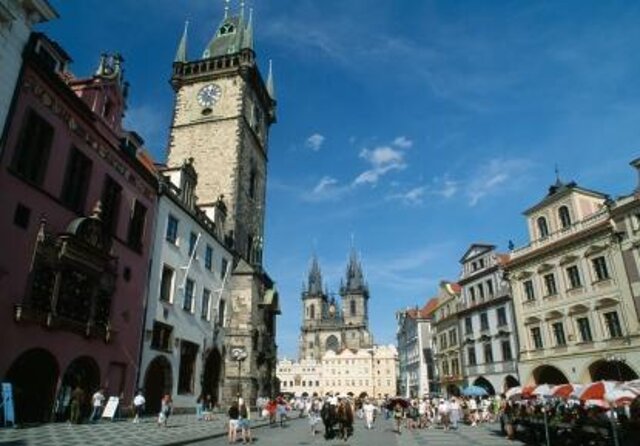
The Old Town section includes Týn Church, the statue of Jan Hus, Saint Nicholas Church, and other major sights. This is likely the most visually concentrated part of the walk, with grand facades and historic landmarks gathered around the Old Town area.
Týn Church is one of Prague’s most recognizable buildings, with its twin towers rising above the square. Saint Nicholas Church adds a different architectural character. The statue of Jan Hus brings the discussion back to religion, reform, and conflict, giving the square a human and political dimension.
This is where a guide can keep the experience from becoming a photo stop every few minutes. Instead of simply pointing out the church, the guide can explain how religious divisions affected Prague and why Jan Hus remains such an important figure.
The Old Town sights are also the part most likely to feel crowded, depending on the time of day. The experience offers a choice of departure times, which gives you some control over your schedule, but no departure can guarantee an empty square. Keep your belongings close and stay aware when the streets are full.
The Astronomical Clock and the story behind the building
The Prague Astronomical Clock is one of the tour’s main attractions. It is famous, but the clock makes more sense when you know the history of the building and the civic life around it.
Your guide covers both the clock and the building connected to it, rather than treating the landmark as a quick picture stop. That matters because the mechanism, the surrounding square, and Prague’s municipal history are tied together.
Do not expect a long technical demonstration or a separate admission to a clock tower. This is a walking explanation from the outside. For many people, that is enough for a first visit. If you want to go inside the tower or spend serious time studying the clock’s details, you would need to arrange that separately.
The stop can be busy, so listen closely and keep your group together. A private guide helps here because you can ask for the explanation to be repeated or clarified without worrying about holding up a large tour.
Entering Prague’s Jewish Quarter
The Jewish Quarter gives the tour its most serious and reflective section. The route includes synagogues, the Jewish Town Hall, the Jewish Ceremonial Hall, and the Old Jewish Cemetery.
These sites are not simply architectural attractions. Together, they tell the story of Prague’s Jewish community, its institutions, religious life, and losses. The Old Jewish Cemetery in particular calls for a slower, more respectful approach than the lively squares earlier in the tour.
The itinerary lists the quarter’s landmarks, but it does not state that admission to the synagogues or cemetery is included. Treat this portion as an exterior and neighborhood visit unless your booking information says otherwise. Food and drinks are also not included, so plan your meal before or after the walk.
This section is one reason the private format can be valuable. You can ask direct questions about religion, community life, and the difficult parts of Prague’s past. A good guide must handle those subjects with care, and the strong feedback for guides such as Via and Tereza points to an approach that combines clear information with an engaging tone.
Finishing near Charles Bridge
The walk usually ends by Charles Bridge. This is a convenient finish because you can continue across the bridge, explore the area around Malá Strana, or stop for a meal nearby.
Ending here also gives the route a satisfying geographic shape. You begin at the Powder Tower, work through Old Town and the Jewish Quarter, then arrive at one of Prague’s best-known river crossings. The tour does not include a return transfer, so plan your next stop from Charles Bridge rather than backtracking to the start.
Charles Bridge can be crowded, especially at popular times. Your guide may finish before you cross it, so save time if you want to walk the full length afterward. The tour’s stated end point is usually by the bridge, not necessarily at a particular monument on the far side.
What the private format is really worth
The clearest benefit is control. Your group is the only group on the activity, so you can ask questions about a particular building, spend more time on political history, or keep moving if everyone has had enough of a subject.
The guides receive repeated praise for being friendly, enthusiastic, and clear in English. Iva is described as upbeat and engaging. Tereza is praised for excellent English and for making a large amount of history fun. Tony is noted for explaining both culture and history, while Via is praised for tailoring the experience to a family and for focusing on Prague’s political past.
That does not mean every guide will use the same style. It does mean the experience is designed around a personal guide rather than a recorded route. If you prefer to wander silently and stop whenever you want, a private tour may feel too structured. If you want answers and context, it is a strong match.
The two-and-a-half-hour length is another point to weigh. It is long enough to cover the major sights without consuming a full day. It is also short enough that the guide must summarize some subjects. I see that as a good first-day choice, followed by independent visits to the places that catch your attention.
Who should book this Prague walking tour?
I would choose this tour for a first visit to Prague, especially if you have limited time and want the city’s core sights explained in one sitting. It suits couples, families, and small groups who want a private conversation rather than a large organized walk.
It is also a good fit for people who like history but do not want a lecture. The route mixes architecture, music, religion, education, politics, and local stories. That variety keeps the walk moving.
You should think twice if you have difficulty walking for 2.5 hours or dislike busy central streets. The tour requires moderate physical fitness, and no food or drinks are included. Comfortable shoes, water, and a little flexibility around crowds will make the experience easier.
Free cancellation is available if you cancel at least 24 hours before the start time. Changes or cancellations made less than 24 hours before the start are not accepted for a refund.
Should you book it?
Book this private Prague Old Town tour if you want a well-shaped introduction with a real person answering your questions. The strongest reasons are the private group, the broad route, the serious Jewish Quarter section, and the finish near Charles Bridge.
I would not book it solely for admission to interiors, since the information provided does not include entrance tickets. Book it for the stories, connections, and efficient walk through Prague’s historic center. At $54.42 per person, it offers good value for a small group that wants personal attention and an English-speaking guide.
FAQ
How long does the Prague Old Town private tour last?
The tour lasts approximately 2 hours and 30 minutes.
Where does the tour begin?
It begins at the Powder Tower, Nám. Republiky 5, Staré Město, 110 00 Praha 1, Czechia.
Where does the tour end?
The tour usually ends by Charles Bridge at Karlův most, 110 00 Praha 1, Czechia.
Is the tour private?
Yes. Only your group participates in the activity.
Is the tour offered in English?
Yes. The experience includes a friendly English-speaking guide and is offered in English.
What sights are included?
The route includes the first Cubist building in Prague, the city’s oldest theatre associated with Mozart, Charles University, Týn Church, the Jan Hus statue, Saint Nicholas Church, the Astronomical Clock, and landmarks in the Jewish Quarter.
Does the tour include food and drinks?
No. Food and drinks are not included unless specifically stated.
Can I cancel for a full refund?
Yes, if you cancel at least 24 hours before the experience start time. Cancellations or changes made less than 24 hours before the start are not accepted for a refund.
Just added around Prague
- WWII and Communism History in Prague’s Old Town Private Tour★ 5.0 · 4 reviews
- World War II 4WD Tour from Prague with Lunch★ 4.4 · 3 reviews
- Wroclaw to Prague: 2-in-1 (Private Transfer + Country Tour)★ 5.0 · 4 reviews
- Prague: Historical Walking Tour with Focus on World War 2★ 4.3 · 12 reviews
- Walking tour of Prague in french: Old Town & Charles Bridge★ 4.9 · 62 reviews
- Ultimate Unlimited Beer Pong with Czech Beer★ 4.6 · 5 reviews
- Walking tour of Prague in French : Nové Město★ 4.9 · 16 reviews
- Prague: Modern Private Spa with Jacuzzi and Sauna★ 4.8 · 62 reviews
Old Town Tours, compared.
3-Hour Walking Tour of Old Town & Prague Castle
Read our review →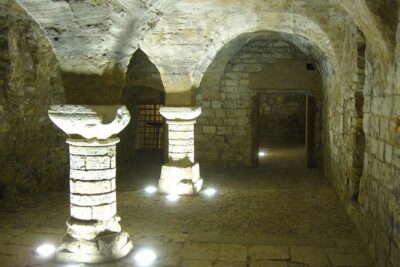
Prague Old Town, Medieval Underground and Dungeon Historical Tour
Read our review →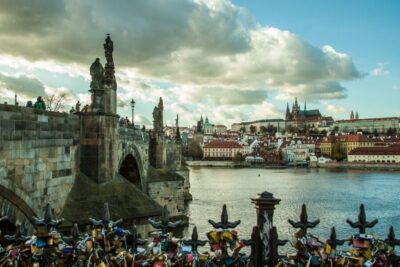
Old Town and Jewish Quarter Guided Tour in German
Read our review →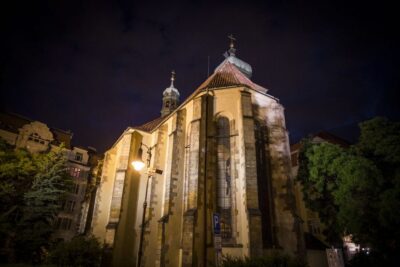
Ghosts and Legends of the Old Town Evening Tour
Read our review →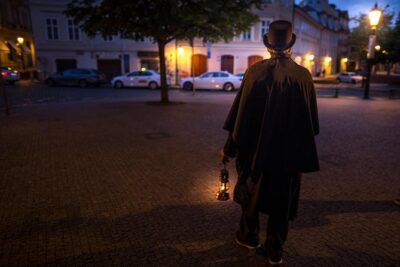
Prague Ghost and Legend of Old Town Walking Tour
Read our review →
Old Town, Astronomical Clock and Underground Tour
Read our review →
Prague’s TOP Sights – Old Town, Jewish Quarter, Charles Bridge (Tip-based tour)
Read our review →Browse the lists this tour appears in